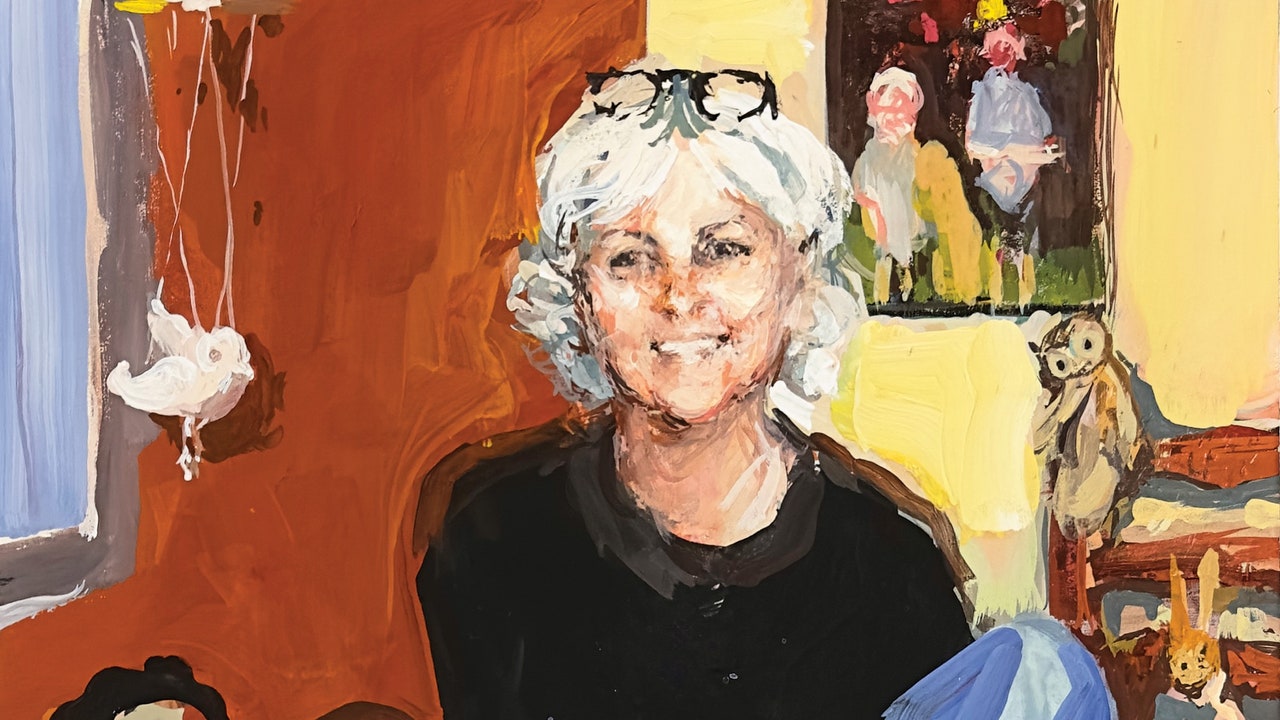
Three winters in a row, Kate DiCamillo went into the hospital, never sure if she would come home and always a little scared to do so. One of those winters, when she was four years old and the air outside was even colder than the metal frames of the oxygen tents she’d grown accustomed to having above her bed, her father came to see her. He was wearing a long black overcoat, which made him look like a magician. “I brought you a gift,” he said, pulling something from his pocket as if from a top hat.
DiCamillo studied the red net bag in her father’s hands, then watched as a set of wooden figurines tumbled out of it: a farmer, his wife, a cow, a pig, a chicken, a barn, a sun, and a moon. All the pieces were roughly the same size—the pig as big as the barn, the sun as small as the cow. Her father began arranging them on the hospital sheet, which was white and crisp as paper. He told her a story about them, then asked if she could tell him one in return. She did, and, for the first time in a long time, she was not afraid of him.
That was half a century ago, but, DiCamillo told me recently, she feels as if she’s never really stopped moving those pieces around. She has written more than thirty books for young readers, and is one of just a handful of writers who have won the Newbery Medal twice. Novels such as “Because of Winn-Dixie,” “Flora & Ulysses,” “Raymie Nightingale,” “The Beatryce Prophecy,” and “The Tale of Despereaux” have endeared her to generations of children who see themselves in her work—sometimes because her human characters are shy or like to sing or have single parents as they do, but more often because their yearnings, loneliness, ambivalence, and worries are so fully, albeit fantastically, captured in the lives of her magical menagerie: a chivalrous little mouse, a poetry-writing squirrel, a “not-so-chicken chicken,” and more than one rescue dog.
DiCamillo is startlingly versatile, which may help explain why, although she has now sold more than forty-four million books, she is not more of a household name. Some of her stories read like fables, stark and spare; others like the memoirs of mid-century children; still others like works of magical realism, ornate and strange. One of her picture books, “La La La: A Story of Hope,” which was illustrated by Jaime Kim, consists of a single repeated word; some of her seemingly simplest stories—an early-reader series about a precocious pig, Mercy Watson, and her neighbors on Deckawoo Drive—collectively read like a grand project, à la “Winesburg, Ohio,” with a wide cast of characters getting the inner lives they deserve.
This fall, DiCamillo will publish the last of the books in the “Deckawoo Drive” series, all of which have been illustrated by Chris Van Dusen, and the first in a series of fairy tales set in a land called Norendy. Next spring, she will publish something entirely new for her: a novel about a child loved since birth, who is adored by her mother and father, neither of whom frighten her or abandon her or die a horrible death. Like all DiCamillo’s other books, this one, called “Ferris,” took her less than two years to write. But in reality, she told me, the novel was decades in the making, because she had to imagine what for her was always truly unimaginable: a happy family.
It is broken families that have made DiCamillo’s career. The narrator of her first novel, “Because of Winn-Dixie,” which was published in 2000, can count on her fingers the number of things she knows about the mother who abandoned her; the protagonist of her second, “The Tiger Rising,” published a year later, has to persuade his father even to speak his dead mother’s name. DiCamillo’s anthropomorphic characters fare no better: the brave mouse in “The Tale of Despereaux,” illustrated by Timothy Basil Ering, is betrayed by his mother, father, and brother, none of whom have any real qualms about condemning him to death, after he commits the grave sin of speaking to a human. “The story is not a pretty one,” the narrator explains midway through the tale. “There is violence in it. And cruelty. But stories that are not pretty have a certain value, too, I suppose. Everything, as you well know (having lived in this world long enough to have figured out a thing or two for yourself), cannot always be sweetness and light.” My favorite of DiCamillo’s novels, “The Miraculous Journey of Edward Tulane,” with pictures by Bagram Ibatoulline, might also be the bleakest: Mr. Tulane, a bit of an antihero, is a haughty toy rabbit “made almost entirely of china,” who is lost at sea by his well-to-do owner; subsequent trials soften his heart, but not before shattering him, figuratively and literally. The book’s epigraph is taken from “The Testing-Tree,” by Stanley Kunitz: “The heart breaks and breaks / and lives by breaking. / It is necessary to go / through dark and deeper dark / and not to turn.”
One gets the sense from the books that DiCamillo knows that “deeper dark” better than most of us, but she has, in the past, avoided letting on just how well. For almost her entire career, she has told the story of her life the same way: she and her mother, Betty, and her brother, Curt, moved from Pennsylvania to Florida when she was five years old, after doctors suggested that her many health issues, including the chronic pneumonia that kept landing her in the hospital, might be improved by a warmer climate; her father, Lou, an orthodontist, stayed behind to tie up loose ends at his practice, and never rejoined the family.
All of that is true, but it is not the whole truth. During a series of long walks around Minneapolis, where she lives, and longer talks in her home, DiCamillo carefully shared with me more of her family’s history. “It’s very hard to talk about, because you want to protect people,” she said one summer night, sitting in the near-dark of her home office. Her tone, always curious and warm, turned contemplative and confiding. There were two chairs in the room with us, but one was occupied by a three-foot-tall rabbit and some puppets, so I was listening cross-legged at her feet; every so often, DiCamillo tried to coax me into switching places. “Even with your friends,” she said, “you just want to protect them from any ugliness.”
DiCamillo’s brother thinks such reticence has been a survival strategy for the siblings, one they were taught to employ. Once, he said, when he was six and Kate was only three, they were at a Penn Fruit grocery store when a woman approached their mother, “saying something like ‘Aren’t you Dr. DiCamillo’s wife? He’s just so wonderful. You’re so lucky to be married to him.’ And she kept going on like that, and my mother just nodded. And when the woman walked away my mother said, ‘They’ll never believe you. You can never tell anybody what your father’s really like, because they’ll never believe you.’ ”
What their father was really like was terrifying. DiCamillo remembers a Christmas Eve when her parents were arguing, and she watched her father hold a knife to her mother’s throat, threatening to kill her, while her mother told him to finally do it. Other images that she carries of her father, even ones connected to her life as a writer, like the figurines he brought her in the hospital, are likewise darkened by fear. When she thinks of him telling her and her brother a story, she conjures a bear, its enormous claws draped over their shoulders—a gesture that the outside world might see as protective but that is really a reminder of how swiftly and effortlessly he could “eviscerate them.”
That terror found fictional expression earlier this summer, when DiCamillo published a story in Harper’s called “The Castle of Rose Tellin.” In it, a pair of siblings and their parents vacation on Sanibel Island; the brother plots to flee, and is badly beaten by his father, who later checks himself into a mental institution. In a text message to Curt, DiCamillo sent a link to the story and described it as a birthday gift for him. “It surprised me, because it certainly didn’t feel like a gift, thinking about our father,” Curt told me, “but also because years ago she was so against talking about any of this.”

“Gas—hit the gas!”
Cartoon by Charlie Hankin
DiCamillo can now see how effectively her father turned his family members against one another, and how trying to please him made it hard to trust anyone else, including herself. When they were still living in Pennsylvania, she would help her father frighten Curt by hiding with him on a gloomy, narrow staircase in their house. She knew that her brother was terrified of that staircase, and knew that her father routinely mocked him for his alleged cowardice, and so she also knew that what she was doing was wrong. As she said in the speech she gave when she accepted her first Newbery Medal, in 2004, even a four-year-old’s heart can be “full of treachery and deceit and love and longing.”
From the time the family moved to Florida, DiCamillo understood, on some level, that her father wasn’t coming. “We had this neighbor, Ida Belle Collins,” she told me, “and I remember Ida Belle Collins asked me right away when we moved when my father was moving down, and I said, ‘Soon, he’s coming soon.’ But I remember thinking, That’s not true, that’s a lie.” She recalls feeling relieved that her father was gone. Her mother found a house close to old family friends who had retired to Clermont, where, in the years before Disney World, the orange trees seemed to wildly outnumber the people. That move to Florida, DiCamillo says, was the first time her mother saved her life; the second time was when Betty, an elementary-school teacher, taught her struggling daughter to read. Kate and Curt played in a tree house in the yard, walked through Jurassic-size jaws into the Gatorland theme park, picked their own kumquats, admired the mermaids at Weeki Wachee Springs, and trekked back and forth from the Cooper Memorial Library carrying armloads of books like kindling.
The third time Betty saved DiCamillo’s life, she threw both kids and their poodle, Nanette, into the family station wagon and drove nearly two hours to St. Petersburg, to the office of the improbably named Dr. Wunderlich. He had trained as a pediatrician—and while in medical school, at Columbia, had dated Sylvia Plath—but, by the time the DiCamillos encountered him, had strayed from the mainstream. In an era when pharmacology was all the rage, he avoided prescribing drugs and was far more likely to scrutinize what his patients were eating, how much they exercised, and whether they were exposed to any toxins—a holistic approach that earned him a reputation as a doctor of last resort.
Both DiCamillo and her brother are struck in retrospect by their mother’s courage and commitment in taking Kate to Wunderlich. His practice was far away and, at the time, far out, but she got better. “I remember standing in front of him in my underwear with all these lumps on my arms and legs from where they had done allergy tests, and I was allergic to everything,” DiCamillo told me. “And he said to Betty, ‘I’ll save her. We can save her.’ ”
On Wunderlich’s orders, Betty radically changed DiCamillo’s diet to avoid all sorts of foods, including sugar, wheat, dairy, and citrus. DiCamillo had allergy shots two or three times a week for years, and the doctor helped her manage both the weeping eczema on her hands and the terrible migraines that still sometimes afflict her. She was soon roller-skating and playing softball with ease. But that newfound vitality disguised an overdetermined sense of the precarity and vulnerability of childhood. Like so many of the characters in so many of the books DiCamillo loved to read, she already sensed that her own wounds, however painful, were also what set her apart.
Although DiCamillo always wanted to be a writer, for most of her twenties, she did everything a writer does except write. She is relentlessly funny in general, and especially so on the subject of her younger self. Per her, she wore black turtlenecks, had a typewriter, and moped; she wrote almost nothing, but wondered indignantly when she would be published. She had gone to Rollins College, in Winter Park, but dropped out after one semester; eventually, she graduated with a degree in English from the University of Florida. Around that schooling, she did desultory work in the Sunshine State: selling tickets at Circus World, potting fresh philodendron cuttings at a greenhouse, calling Bingo at a Thousand Trails campground resort, donning a polyester spacesuit and telling people to “look down and watch your step” at Disney World’s Spaceship Earth.
It took a different geographic cure to turn her into an actual writer. When DiCamillo was twenty-nine, a friend of hers announced that she was moving closer to family in Minneapolis, and DiCamillo decided to go along. She didn’t know much about Minnesota, but she knew it was nearer than Florida was to the Iowa Writers’ Workshop, which she dreamed of attending. Soon after moving, in 1994, DiCamillo got a job at the Bookmen, a wholesale book distributor in the warehouse district. “The building was like something out of a Dickens novel,” she said. “It had been a plumbing business, so there was this old brick with ‘BETTER HEALTH THROUGH BETTER PLUMBING’ painted on the side in huge letters.”
DiCamillo never applied to Iowa, but she did create her own kind of workshop, getting up every day to write before her shift—first an hour early, then two hours early, at 4:30 A.M., setting herself the task of producing two pages a day. She chose the predawn hours because neither the rest of the world nor her inner critic was awake yet. Sitting at a desk that her brother helped fashion out of a wooden fence from their back yard in Clermont, she wrote by candlelight and lamplight. She submitted short stories to every magazine for which she could find an address, including this one, and she kept submitting them long after others would have called it quits.