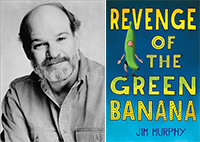
Author of more than 30 works of nonfiction, including Newbery Honor books The Great Fire and An American Plague, as well as a handful of historical novels for middle graders, Jim Murphy shines a light on a chapter of his own young life in his latest book. Due from Clarion on January 3, Revenge of the Green Banana offers a humorous – more or less fictionalized – glimpse of Murphy’s sixth-grade year at St. Stephen’s, a Catholic elementary school in Kearny, N.J. The novel’s title refers to a prank that Jimmy Murphy and his friends plan to avenge vindictive Sister Angelica Rose, the teacher who volunteers Jimmy (the self-described “worst student in our grade, if not in the whole school”) to perform onstage with second graders – wearing a green banana costume. Murphy spoke with PW about how his real life fueled his latest work of fiction, and about his varied experiences with children’s publishing.
The protagonist of Green Banana bears your name, and you open the novel with a “Warning” that wryly turns the standard fiction disclaimer on its head, noting that everything in the book is true, and no names have been changed to protect the identity of the innocent or the guilty (“especially the guilty”). Is it safe to assume there’s a very fine line here between real-life and fiction?
I can say that most plot elements of the novel actually happened, and all of the characters are real, though not everything in the novel occurred during my sixth-grade year – some of the events happened during my other years at St. Stephen’s. I did add some fictional things, but the story is mostly true.
And the obvious question: as a sixth grader, were you really forced to appear as a green banana in the second-grade performance?
I wasn’t actually a green banana in a school play, but in fourth grade I was cast as the lead “fireman” in a production, and had to wear a hat and yellow slicker and I hated it. I rebelled, and there were long negotiations, and in the end I agreed to do it if I could bring my Mad magazines to school to read in the downtime during rehearsals, which happened. I learned at an early age that you should never give in right away – negotiate!
Given its grounding in fact, did you ever consider writing Green Banana as nonfiction?
Yeah, I kept tossing that idea around, but decided that it wouldn’t be fair to write this as nonfiction. I certainly don’t think some of the things the nuns at my school did were fair – but they were dealing with class sizes of more than 60, and I know I was an annoying kid and a provocateur. I was definitely a target of their physical and emotional abuse, but I always walked away – and never had any broken bones. To this day, I’m not at all sure how good my education was. I am the worst speller, and I make up grammar as I go along. Still, I came out of St. Stephen’s a ferocious reader – and a very determined individual.
What was your first brush with publishing?
In high school and college, I wrote a bit, but I didn’t think I was smart enough to become an author. I thought about becoming a children’s book editor, because I loved illustration, but I wasn’t a good enough artist to illustrate professionally. My mother, who at four foot 11 inches refused to accept the word “no” from anyone, out of the blue invited Harold Latham, president of Macmillan and editor of Margaret Mitchell’s Gone with the Wind, to our house for dinner, so that I could talk to him about working in publishing. And after I graduated from college, my mother told me to write to 40 children’s book editors to make an appointment to talk with them – even if they had no job openings. But no one would hire me because I couldn’t type!
Did your – or her – persistence finally land you a publishing job?
Well, I’d started working for my uncle, a construction foreman, to earn some money, when one day I was called down from the 20th floor of the Grace Building in midtown Manhattan to take a phone call. It was from Jim Giblin at Seabury Press, who decided to hire me even though I couldn’t type – I think he took pity on me. Jim was a fabulous mentor, and taught me how to analyze a manuscript and how to help the author make it better.
And at what point did you decide that you wanted to be writing those manuscripts?
I was doing a bit of writing while at Seabury, but at one point, toward the end of 1977, it occurred to me that all these authors I was working with were having books published with their names on them, and getting royalties, and I thought, “I’m going to wake up one day and I’ll be 65 and it will be too late.” So I left Seabury and started writing fulltime.
Was that smooth sailing from the start?
I went into being a writer with the notion that I was going to write fiction, and of course it would be brilliant. And of course it wasn’t. I wrote a manuscript based on my personal experience, and sent it to Norma Jean Sawicki at Crown. She told me the story had a lot of potential, and we went back and forth, until I finally said to myself, “This is hopeless. I don’t know what I’m doing.” My manuscript was thousands of pages long – it was gigantic and out of control.
Did Norma Jean agree?
Yes, so I brought the manuscript home. And one day soon after that, I was in my office and heard the sound of the garbage truck – coming closer and closer. So I picked up the manuscript, ran outside, and placed it on top of the garbage can. And the truck took it away. When I called Norma Jean to tell her that it was gone, she said, “Give me a nonfiction idea, and I’ll buy it.” And so I did – a book about inventions – and Crown published it as Weird & Wacky Inventions in 1978. And I was a published author.
And one hooked on writing?
I guess I was. I remember that I wanted to come up with a book idea that was unusual, so I decided to do a history of tractors, which I thought kids would like. It revolved around the illustrations – showing different views of old tractors. One day, I was telling my dad about the project. He had a very wry sense of humor, and he said, “Jimmy, that sounds like it’s going to be a big hit – in Russia.” I laughed, and realized he was right. The book was something you could drop in water, and it would sink!
So did you scrap that project idea?
Not exactly. I asked myself, “What am I going to do with this?” And I realized that an interesting thing about tractors, especially steam tractors, is that they exploded a lot. So I wrote a history of tractors, knitting together first-hand accounts of people who had survived tractor explosions. The book was titled Tractors: From Yesterday’s Steam Wagons to Today’s Turbocharged Giants, and was published by Lippincott in 1984. It got pleasant reviews, including a starred one from SLJ, and I wondered what it was that made this book work. And I realized that the key was the first-hand perspective, and from then on I knew that it was important for me to do first-person accounts.
Did you follow your own advice?
Yes, and I discovered different ways to do the first person. When I began writing The Boys’ War, I had lots and lots of interesting quotes, but my wife [writer and editor Alison Blank] said that the quotes I’d used had created very long blocks of text, and she suggested I shorten the quotes and write them as dialogue, explaining that it was real. And that’s what I did.
And that reformatting worked?
I guess so – the book did very well. I worked really hard researching that book, as I do all of my books. And it takes me a long time – usually three to five years. In this case, after my long slog researching and writing The Boys’ War, it was published in 1990 in the same week Ken Burns’s The Civil War came out. My book was displayed in some stores right alongside his! I say that my book ran on the coattails of his book for years and years.
The luck of the timing draw?
Yes, timing can make a difference. When An American Plague came out in 2003, there was a lot of panic and discussion about the SARS virus. It made all the media headlines, which helped draw attention to my book. You just never know. When I decided to write the novel that became Revenge of the Green Banana, I initially thought I might do something fictional that would go along with current headlines – but the novel obviously became something very different.
And what can your fans expect next?
My wife Alison and I are now working on a nonfiction book focusing on the devastating social effects of leprosy. And I’m also writing a novel about a girl who passes as a male soldier during the Civil War. I’m able to draw on research for earlier books I’ve done on the Civil War, plus am researching new material. Beyond that, I’m not entirely sure what’s ahead. Alison has told me that when I’m writing nonfiction, I come downstairs from my office with a scowl on my face, but when I write fiction, I’m happy. And she’s right – I kind of relax when I’m doing fiction. So that may be a good reason to focus more on that.
Revenge of the Green Banana. Jim Murphy. Clarion, $16.99 Jan. ISBN 978-0-544-73651-1