
Arthur Seefahrt, Decay Studies (Six Gallery Press, 2024)
Arthur Seefhahrt is a Dublin-based poet whose new collection, Decay Studies, has just been published by Six Gallery Press. Seefahrt works in a range of media, including photography, sonic experimentation, multimedia installation, and live performance. He holds advanced degrees from Columbia University, Trinity College Dublin, and University College Dublin. The poet, Timothy Donnelly, called Decay Studies a “breathtaking debut, and one whose ostensible focus might be decay, but whose achievement is decay’s opposite – preservation.” Sean Borodale calls Seefahrt’s debut a “language-based laboratory.” Meghan Maguire Dahn writes that Decay Studies “models for us a practice of looking so closely that edges, holes, absences, and ‘nothings’ provide a ground for full being where the ablative is a path to good.” I spoke with Seefahrt about edges and absences, making and unmaking.
Poet Arthur Seefahrt, author of Decay Studies.
Salyer: One of the building blocks of Decay Studies is the idea of “ablation,” meaning a process of chipping, eroding, or vaporizing. It’s the frosted effect that electricity’s arc makes on glass. With AI or genetic sequencing, it shows us the point where loss-of-function. What work does ablation do in Decay Studies?
Seefahrt: I’m glad that you included definitions that denote negation and undoing, as well as their residual effects. I wanted to enact ablation both in life and on the page for some time. I’ve been working at some version of this for longer than I realized until I completed this collection.
For a long time, I imagined literature as canon, a kind of Bible, a multi-authored text of great cultural significance. Later, I realized how limiting this was and I began thinking of literature as something that included all voices, whether written or not, something authorless, sometimes sung, nameless as stories overheard in pubs, language as endless and emanating. Think of a broadcast sending radio waves into space.
So, “ablation” became a way of thinking through what it would mean to add a moment of silence to so much beautiful noise. It’s the simultaneous elimination of a thing, the erosion process, that also leaves behind a residue. That’s the impulse driving the poems in Decay Studies.
But this is more than performing an act on the page. Many of the poems in this collection were composed during the world’s longest lockdown in a walled garden near Dublin. Writing these poems became an examination and ablation of ego, the point at which the ego loses function. From there, the work became closing the gap between perception and the truth of a thing itself. But first I needed nothing as a starting point. The ablative mode of this collection is a threshing, a moral act.
Salyer: Poems in Decay Studies’s “MU” sequence are “page representations of the text portion of a multimedia installation.” Could you say more about your sense of translating between different media? It there a relationship between ablation and ekphrasis?
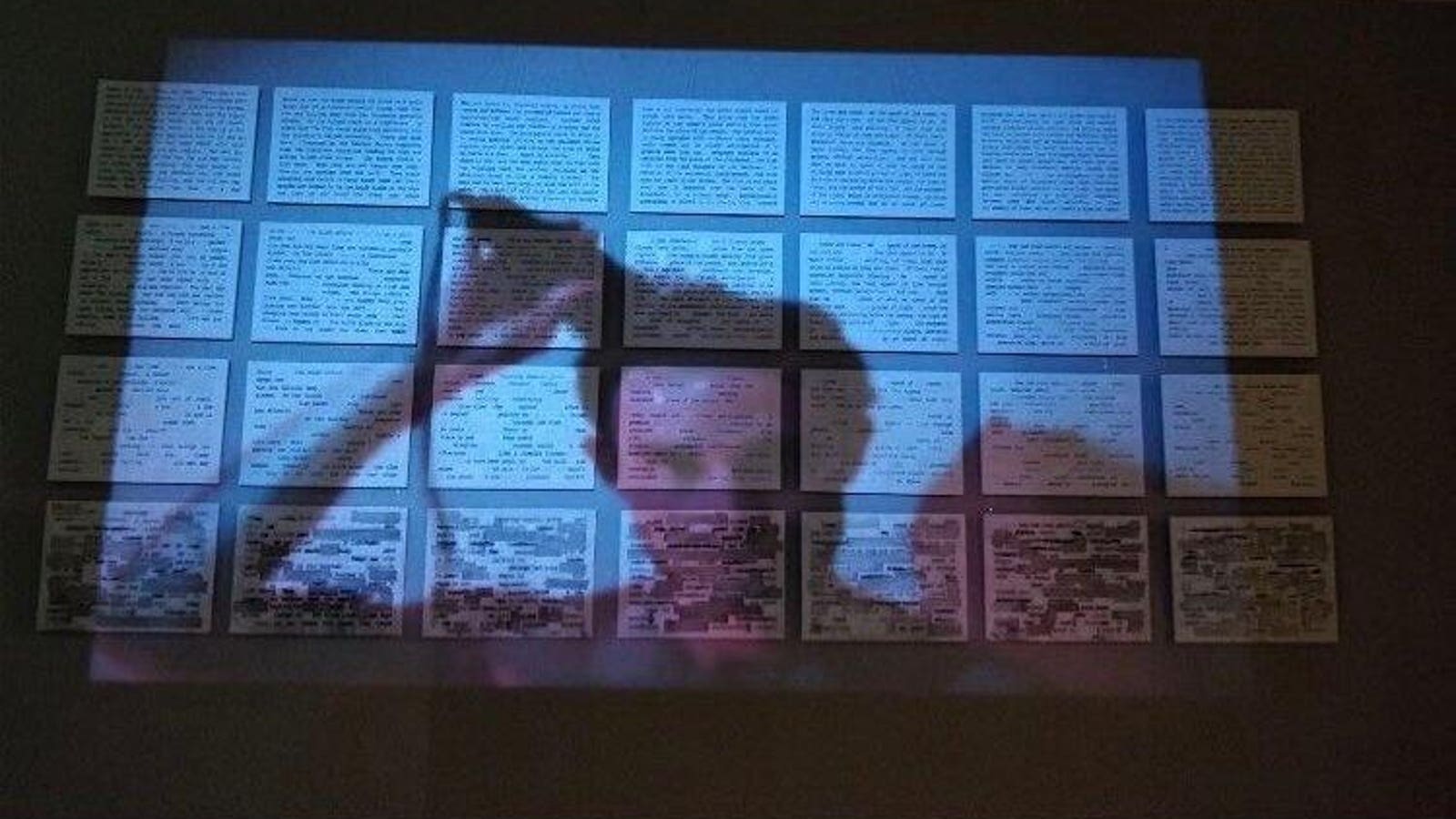
Seefahrt: Decay Studies grew out of a week-long installation at Dublin’s Ranelagh Arts Centre in 2018. I’d received visual and performing arts grant funding from Trinity College, and I’d always wanted to make paintings. That’s not a skill I possess, though, so I combined my interests in filmmaking, sound design, and wall objects into a single concept.
I’d been granted visual and performing arts grant funding from Trinity College, and I’d always wanted to make paintings. That’s not a skill I possess, though, so I compressed my notions of filmmaking, sound design, and the wall-object into a single concept. I made a short Super 8 film that interspliced scenes of me shaving my head with shots of a forest canopy, the seashore, and the empty sky – basic images of symbolic death and renewal.
Decay Studies (2018)
The “MU” poems that appear in the book were arranged on the wall in 7 columns with each poem screen-printed 4 times. The top row was the unadulterated print, and the subsequent rows descending employed various forms of physical erasure from painting over the text in white to covering them with medical tape and, finally, slashing out the words, eliminating them physically altogether.
I projected the film over these images, and a synchronous loop be me reading the poems played as the film looped on the canvas. Each iteration of this layered another recording, so that by the 4th iteration, the poems were a 4-track recording of layered voices. This highlighted their unplanned convergences and echo effects, emphasizing moments in the language through process rather than planning. I wanted to see into the heart of the thing I’d made.
I was unsure whether these poems could “live” on the page alone without support, but they reach for the emptiness of vision I tried to attain. I needed to make them as things in the world before I could trust myself to make them things on the page.
Poet Arthur Seefahrt
Salyer: Speaking of things in the world moving to the page, I’d like to ask after the landscape in Decay Studies. It’s as pastoral as it is experimental. Were there none of what the book calls “ablative whiteness” about it, what would a man make of the fox, the apple tree, the shed, the garden walking through this book? Would it be a trick of the imagination? Or is place – perhaps particularly a kind of Irish landscape – something so hard to talk about because it’s been talked about so much, and talked about so much because it has a nonhuman truth to it?
Seefahrt: I think I’d have to return to an earlier answer about the relationship between the perception or expression of something and the truth of the thing itself. While it’s true that Ireland is rife with excellent poets who interact with an extremely well-developed, nuanced pastoral tradition, it’s not so much landscape in the pastoral sense, but the alienness of landscape to perception that gave me a “way in” to these places. When one is essentially confined to a walled garden for the better part of two years, that limitation of place becomes an extension of self.
It’s not that I saw the garden as mine or sculpted it to my will. It became an extension of myself through a desire to seek meaning from the limited range of objects available for experience during lockdown. I sought the expression of the truth-of-things-themselves in the garden only to be confronted by the reflection of my own interiority. The ‘ablative whiteness’ arises from the nearby sea, and in a Conradian mode, indicates the groundless confusion of the moral self.
If you recall, the Irish government parcelled out lockdown extensions in packets two and three weeks, repeatedly. This probably kept people in line who hadn’t copped on to the fact that this or that extension wouldn’t be the final two weeks, nor even close. So, I existed in this very defined place for an very indeterminate period and I found myself reflecting intensely on the limited objects available to me.
The night, the fog, the indication of sky beyond the garden walls, were all to me places of refuge. Simultaneously, they staged confrontations with the ongoing dissolution of self, whether intentional or brought on by the altered conditions of confinement, seemingly without definite termination. All of this highlighted the division between the perceiving self and all that is. Even in the night without sight of your hand you are still aware that it is your hand.
Untitled landscape
Salyer: That tension between limit and the indefinite reminds me of the great in-betweenness of midlands, boglands. In the poem, “Midlands,” there’s a wonderful stanza – “A fox on the road /ahead crushed in Xmas /haste displays its splayed skull / colouring the scene.” I wish I could steal it. “A head” / “ahead.” The enjambments. Almost the splayed skull of haste. The poem haunts itself in a manner of speaking, like boglands. What is it to perform “decay studies” in or as liminal space like this?
Seefahrt: I like that stanza, too. Sometimes, you’re so in the groove that you surprise yourself, and little mimeses are birthed from the churn. I suppose at the heart of these poems that ablate and inhabit landscape is a question: “how well do I know myself?” The spaces and landscapes of Decay Studies are places of interiority, verging on a narcissistic obsession with the idea of selfhood. At the same time, these places span the gulf between the perceptible, that which can be expressed, and the things themselves. They’re inhabited by a self and are sprung from the commingling of the self and the world.
“Midlands” is probably the poem in the collection which is most directly linked to contemporary Irish poetry. It’s an attempt to place myself in what was at the time (and will always to some degree be) a foreign landscape for me. I took a bus ride to a rented cabin in Cavan for my first Christmas abroad, alone. “Midlands” is a result of the impressions I collected on that journey, combined with an imagined Ireland that I had only read of in poetry, particularly in Seamus Heaney’s work.
I do not recall which critic brought this analysis forward, but it’s something that has coloured my reading of Heaney ever since: Heaney is a poet of place, but also of transition. Apart from the many very grounded poems in his first collection, Death of a Naturalist, he most often observes his native landscapes from a vehicle, or while moving through them. Whether driving the tree-lined roads of Antrim in “Crossings xxxi” or driving along “The Flaggy Shore” or his journey by boat in “Holding Course,” he is most often somewhere along the way, reflecting on a journey remembered. And in this way is memory not the landscape that time ablates? If we tune our attention to it, “decay studies” are perpetually occurring. Our understanding of a moment, once remembered, changes with each recall, both in detail and in meaning. But if memory is the stuff of identity, we are in a continual state of ablation, becoming the residue of self, just as a crushed fox on the road becomes the bog.
Decay Studies is available from Six Gallery Press here.
Discover more of Arthur Seefahrt’s work here.