
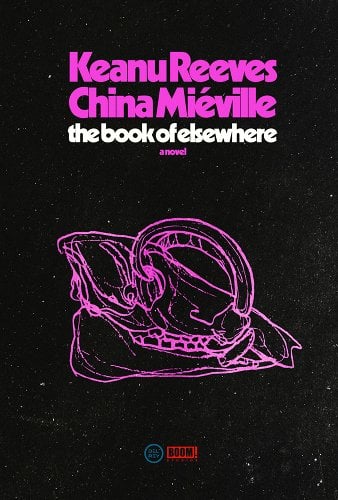
Eight years after his last novel and reputedly, a year before his magnum opus lands — China Miéville has added a new type of genre to the mind bendingly varied list of books in his oeuvre — the tie-in. In 2020, movie star Keanu Reeves originated and co-wrote the BRZRKR comic series about an immortal warrior named Unute, loosely affiliated with a secret division of the U.S. Army under the codename B. Although there’s no way of compelling him to do anything, he accedes to most orders in return for specific scientific help that he cannot do himself.
At first glance, The Book of Elsewhere is a match made in Gen X heaven. The ad copy almost writes itself: The greatest living SF writer of our generation pairs up with Neo from The Matrix (or Johnny Mnemonic, if you prefer) to tell an epic tale of speculative fiction that runs through the whole of human history. The only problem is that the core of the story comes not from the writer who is a Fellow of the Royal Society of Literature and winner of the Arthur C. Clarke Award, British Fantasy Award, BSFA Award, Hugo Award, Locus Award, and World Fantasy Awards but from the actor more famous for traveling through human history as Ted of Bill and Ted.
That latter characterization is slightly unfair to Reeves whose work with Matt Kindt on BRZRKR (drawn by Ron Garney using a lot of red ink) is fine — even interesting. But it does underline the basic mismatch of the novel’s production and why Miéville is always playing catchup. His task in The Book of Elsewhere is to represent the maelstrom of a warrior demigod, but also to describe his growing ennui and provide an account of Unute and the cast of characters who’ve surrounded him for 80,000 years.
This is no trivial undertaking. Where the comic provides minimal text and almost unremitting gore centered on Unute, Miéville has to provide context, motivation, characters, and plot to round out The Book of Elsewhere. Where the comic series pastes the requisite anachronistic superhero musculature onto a young, bearded Keanu Reeves who rips armies apart with his bare hands, Miéville has to build a compelling human, historical drama in the empty space around a scant mythology and millennia of bloody war. In short, he has to tell the story of this heart of darkness at the center of human history. He has to make Apocalypse Now out of the Vietnam War.
To meet this challenge, he turns to Freud and a pig.
From Freud, Miéville borrows the idea of the ongoing human struggle between the life and death drives. Readers — and Unute himself — wonder whether Unute is an agent of death or instead a more Promethean figure, preserving and distributing technology, innovation, memory. And Miéville also riffs off Freud for some parental intrigue surrounding Unute. That doesn’t mean Unute does a lot of Oedipal processing, thank goodness, but he does contemplate his primal scene. That scene, however, is pretty anomalous, given that Unute was conceived through some sort of divine blue lightning and his birth took place well before the appearance of the Bering Land Bridge—the strip of land that once connected Asia to Alaska.
Bizarrely, but perhaps appropriately, Unute’s search for answers and enduring company also find a tentative response in the shape of an immortal babirusa (Indonesian deer-pig) whose history mirrors his own. It’s a brilliant move by Miéville to project a twin warrior—however monstrous and non-verbal—for Unute to ponder, care for, and try to understand.
Along with the inordinately long historical scope, the philosophical and psychological underpinnings of the novel are perhaps its most ambitious aspect. The exploration of immortality, the death drive, and the human condition weave through the narrative. They are Freudian but not slavishly so.
The Book of Elsewhere is appropriately ambitious and fans of Reeves, Miéville and the BRZRKR series will find much to appreciate. But its ambitious themes sometimes dissolve amidst the chaos of the plot. The novel tries to be true to the BRZRKR roots of action as well as a profound philosophical inquiry, but it doesn’t fully succeed in either realm.