
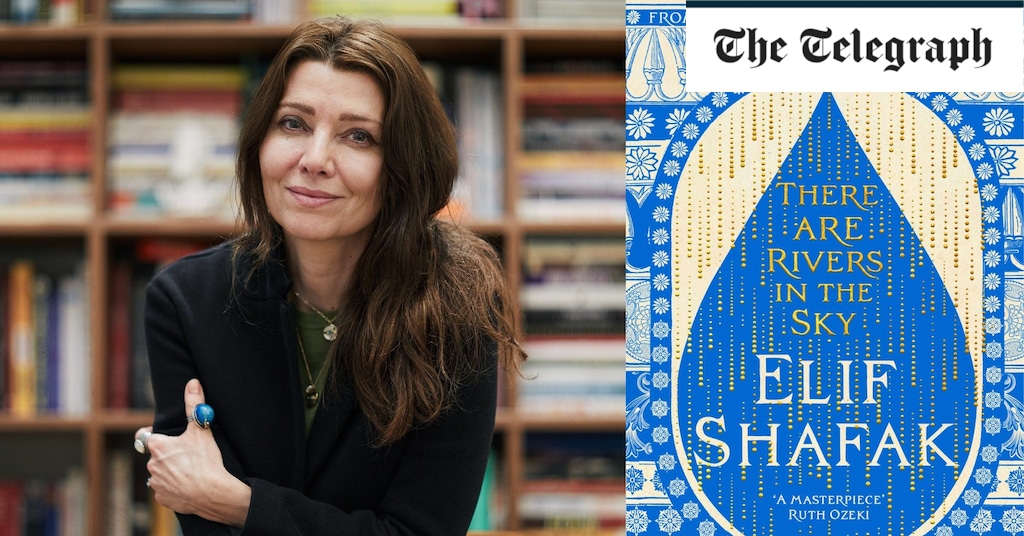
Elif Shafak is no stranger to multi-perspective stories that stretch across decades, countries and cultures; but There are Rivers in the Sky is unusual. The three protagonists in the Turkish-British writer’s 13th novel may live in different times and places, but they’re connected principally by water.
First, there’s Arthur, born to abject poverty by the banks of the Thames in 1840. His mother, Arabella, is a tosher: a river scavenger who picks scraps from the river’s foetid sludge to provide for her growing family. (Her husband drinks the money that should be feeding their children.) Raised in penury, Arthur is gifted – or cursed – with a prodigious memory and intellectual abilities. Formal education is beyond his reach, but his talents secure him a job with a master printer, and eventually a position at the British Museum, where he’s tasked with deciphering the cuneiform tablets excavated from the library of the Assyrian king, Ashurbanipal. From these fragments, Arthur pieces together the first incomplete reading of The Epic of Gilgamesh, before setting off for Iraq, intent on discovering the missing tablets.
Next there’s Zaleekhah, a modern-day hydrologist who, fleeing her broken marriage, moves to a houseboat on the Thames, not far from where Arthur was born nearly two centuries before. Upon noticing a leaking sink, she seeks out her landlady, an Irish tattoo-artist named Nen: the latter runs a studio opposite the British Museum where she specialises in inked cuneiform, and has a penchant for mudlarking where Arthur’s mother once sifted silt. As the two women grow closer, Zaleekhah is forced into an emotional reckoning with her parents’ long-ago deaths in a flood, and the effects of having been adopted by her wealthy uncle Malek who, like her mother, came to Britain from Iraq.
Finally there’s Narin, a young Yazidi girl brought up by the banks of the Tigris in south-east Turkey, in a village that’ll soon be inundated thanks to a newly constructed dam. She descends from a line of healers and seers, including her great-great-grandmother – who captured Arthur’s heart when he arrived in Nineveh to dig for those missing tablets.
Narin is slowly becoming deaf, and in spite of rumours of violence, her beloved grandmother and musician father decide to journey together to northern Iraq, to the Valley of Lalish, so that Narin can be baptised at the temple there before she loses her hearing completely. The year is 2014, and Isil are yet to launch their military offensive. Massacres, forced conversions and years of human trafficking lie ahead; but for now, Narin drinks in the sounds, sights and smells of her village while she can.