

Yellow stained glass windows put a late-afternoon glow into the Great Room at the Internet Archive in San Francisco, site of the annual Books in Browsers Conference.
By Porter Anderson
Brian O’Leary needed no time at all to sort out what he thought was the guiding principle at this year’s Books in Browsers (BiB) Conference — produced by Peter Brantley, Kat Meyer and the Frankfurt Book Fair — and which took place last Thursday and Friday (October 24 and 25) in the Great Room of San Francisco’s Internet Archive.
“Creative collaboration was the persistent underlying theme,” he said.

Brian O’Leary
A veteran publishing consultant and frequent speaker at the conference, now in its fourth year, O’Leary’s continually evolving perspective is credited by many with helping to establish one of the underlying principles of the event: the “Context, Not Container” assertion, which states that digital publishing demands to be freed from automatic, traditional ideas about what constitutes a “book.”
“New forms of writing and reading, new tools for creating and sharing and the growing dialogue between creators and consumers—most readily evident in fan fiction, but it won’t stop there—are all pushing us to develop an architecture of collaboration,” said O’Leary.
On the Saturday after the event, some 40 people — including Columbia College Chicago’s Steve Woodall, Clifton Meador and, by remote, Robin Meador — gathered at conference sponsor swissnex’s San Francisco offices to team up for the first Books in Browsers Hackday, where participants were invited to:
Spend a day hacking the traditional definition of a book and building new digital interpretations. The Books in Browsers Hackday is an opportunity for active software engineers and designers to work together to build interoperable projects using openly available or donated code, content, and APIs.
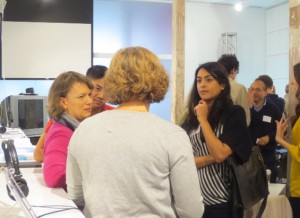
Participants in the Books in Browsers Hackday chat at San Francisco’s swissnex.
Need a minute to catch up?
It’s OK, you’re not alone. And we’ve got help.
When we talk about “hacking a book,” what we mean is to electronically intercede, if you like, in a book’s text and/or ideas. The purpose is to act on or with that book’s concepts, looking for something “else” that can be done with those concepts, something non-traditional, unexpected, and non-bookish.
One key approach for many is referred to — echoing O’Leary’s emphasis — as “collaborative annotation.” This is a drive to make it possible for people to comment on everything, annotate everything. And yes, they mean everything. “Even if the comments section is turned off,” as they like to say.
Everything in the information sphere should be accessible to the thoughts, opinions, and commentary of everyone else, without gatekeepers or delimiters in the way.
One example comes from the San Francisco non-profit hypothes.is, where Books in Browsers’ Peter Brantley is based. The company is working to develop “an open platform for the collaborative evaluation of knowledge” — annotation. Their explanatory video takes you from from the beginning of recorded information to our current moment of the search for universal collaborative commentary.
Here’s one line from that video that will help you get it:
A world that listens when you have something to say.
That’s the dream. That’s an “architecture of collaboration” at about the highest level we may be able to conceive right now. Authorship changes. Publishing changes. Ownership of information all but vanishes. A “book” becomes, among many other things, a chance for the world to hear you say something.
Hacking the Book

Kate Pullinger and Dominique Cunin confer on their Books in Browsers Hackday project based on Pullinger’s forthcoming novel “Landing Gear” at swissnex San Francisco.
“What name should we give to this?” Dominique Cunin of Paris’ École nationale superiéure des Arts Décoratifs speaks a meticulous English. He sounded at the Hackday to American ears like the late François Truffaut at about age 30.
At the Hackday, he was sitting next to Kate Pullinger. Near them, another table of folks worked on an annotation project, using hypothes.is’ technology. Another group was experimenting with text-recognition software with a goal to making a hacked book accessible to blind readers. Another group, rooted in the Safari Books camp, proclaimed a special fondness for robots.
“The original tableau is called ‘Dark Mass,’” Pullinger told Cunin in answer to his question about a title for the excerpt of her book they were working with.
Pullinger is a Canadian novelist, professor, and opera librettist based in London. She sat sat hunched over her laptop beside her collaborative Frenchman. She was referring to the text on-screen and hand-writing lines for him from her forthcoming novel Landing Gear (May 2014 — Doubleday Canada, and Simon & Schuster’s Touchstone in the States), editing whenever necessary to make her text fit on the front and back of a virtual piece of paper Cunin had generated as a jittering, glowing image on his laptop screen.
Cunin was using the experimental computer programming language he calls “Mobilizing” to try to make that piece of paper appear to flip in mid-air — much as does one of Pullinger’s characters, Yakub, a Pakistani migrant worker from Dubai, in a harrowing scene, which reads, in part:
I am free.
I am flying.
I am falling through the air.
“I can cut the text some more if we need.” Pullinger had culled about 150 words from the scene in question so far.
“If we go to too much detail,” Cunin said, “we will have to multiply the effects and screens.” This was an explanatory “yes” — so do cut some more text, please.

From left, David Harris, Bill Levien, and Meghan MacDonald work on a Twitter bot project related to Kate Pullinger’s “Landing Gear” at the Books in Browsers Hackday.
As Cunin and Pullinger pressed on, David Harris and Bill Levien were working separately a few tables away at swissnex on producing a Twitter bot that could tweet out lines of text from a character in Pullinger’s novel. Harris is with the Proceedings of the National Academy of Sciences of the USA. Levien is a Mobile Product Manager with Safari Books Online in San Francisco, another sponsoring presence at Books in Browsers.
Both groups were assisted by Meghan MacDonald. She manages digital product development for Penguin Random House Canada and works with Pullinger’s publisher and editor at Doubleday Canada, hence her representation of the publisher at such events as this.
These projects based on Landing Gear were possible because MacDonald arrived at the Books in Browsers Hackday with a Landing Gear API, an invitation to these folks to hack an excerpt of Pullinger’s book as they saw fit.
You’re getting this right. Random House traveled to San Francisco and joined an author in offering up part of a book for hacking. A Big Five component was there, making possible this exploratory development way beyond what currently is scheduled for publication next spring when “Landing Gear” is released.
O’Leary wasn’t joking about collaboration.
The New, Globalized Generation of Internet Publishers
As O’Leary told us, “This year, Books in Browsers billed itself as ‘a small summit for the new generation of Internet publishing companies, focusing on developers and designers who are building and launching tools for online storytelling, expression, and art,’ a description it met fully. The agenda featured speakers from England, France, Iceland, Germany, Switzerland and New Zealand.”
A quick look at the attendee list for Books in Browsers this year might have held some surprises, too, for those who think a “new generation of Internet publishing companies” is too newfangled for mainstream publishers.
Here were representatives not only of Penguin Random House Canada, but also from Macmillan; both the Penguin and Random House sides of the Penguin Random House estates in New York; Perseus Books Group; Pearson; Harlequin; Amazon; Hachette Book Group; Knopf Doubleday; Wiley; Harvard Business Publishing; the Book Industry Study Group (BISG); International Digital Publishing Forum (IDPF)–in fact, Bill McCoy joined us at the Hackday; and many more, the total attendance approaching 300 receptive, chatty, busily networking souls.
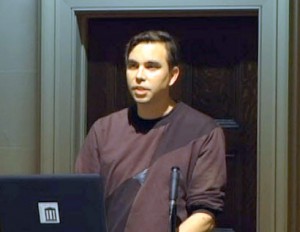
James Bridle describes his concept of “Network Tense” to the assembly at Books in Browsers in San Francisco.
Perhaps most compelling in terms of our common search for a language to discuss what all this means was the London-based writer and speaker James Bridle’s presentation, an unscheduled major addition to the program.
Bridle, whose home online is BookTwo, told the audience he’s searching for “Network Tense,” a way to talk about “placing our memories and experiences ‘outboard’ on the network.”
The literature itself is a coded space…there’s been technological augmentation of the writing and reading processes for as long as there’s been writing and reading. But what happens is the network renders that process more visible. It gives us new ways of understanding and thinking about it, if we can understand and think about the network as well. So for some time now, I’ve been trying to think about how one writes in the style of the network.
That style of writing is what he means by “Network Tense” (as in past tense, present tense, future tense, Network Tense). It’s still elusive, he conceded, but, in one way or another, it’s the fundamental inquiry of all we saw and heard at Books in Browsers.
Publishing Perspectives’ Deputy Publisher Hannah Johnson has produced a series of three smartly focused spot-coverage stories highlighting some of the presentations on stage.
In Books in Browsers IV: The Rise of the Reader, Johnson wrote of Leanpub co-founder Peter Armstrong’s presentation of serialized fiction, particularly as it echoes the iterative, “agile” format of production his company’s work favors.
She also wrote of Say Books‘ Anna von Veh’s appeal for attention to fan fiction as a model of reader-driven (user-generated) content:
“The readers are the writers,” von Veh said. “We have to engage with them in some way.” Though exactly how publishers might engage or monetize fan fiction is not clear.
And she included the example of Adam Hyde’s Book Sprints session that “brought together oil industry experts together to conceive of, create, edit and produce a book about oil industry contracts…At 49,800 downloads, the book has reached a very targeted audience.”
In Books in Browsers IV: Get Ready for More Context, Johnson highlighted Exprima Media’s Corey Pressman and his use of paratext, “’a zone between the text and the off-text’” (that) includes factors that influence the reception and consumption of a piece of content.” She also covered a presentation from hypothes.is in which Dan Whaley and Jake Hartnell discussed annotation, that “layer of discourse over the top of the Web” and Zurich’s Anthon Astrom of Astrom/Zimmer, with his research project Lines, “a format that brings more context and richness to online content and small screens.”
Finally in Books in Browsers IV: Why We Should Not Imitate Snowfall, Johnson wrote of the New York Times designer Allen Tan’s neatly prepared, articulate presentation on how the terms “intuitive” and “immersive” have far less actual meaning than many of us think they have. He prefers, as Johnson writes, “legibility (how users know they can scroll or click), metaphor (how users understand something like a virtual scroll or a window to pan through), and skills (can users actually operate the technology).”
“Network Tense” and the Tension of Good Programming

Kat Meyer
In the words of Kat Meyer, “This year was all about the user. ‘User’ as in reader,” she said, “but also as maker.”
Meyer recalled a disagreement with co-conference organizer Brantley that proved representative of where the presenters were, as well. “It had to do with the T-shirt motto, ‘One does not simply put a book into a browser,’” she said.
(In a new post coinciding with this one, Critical Making, O’Leary looks at this motto, as well.)
“Peter said the point of the conference was that one simply does put a book into a browser. And I got all up in arms and said, no, the sessions this year are almost all about the act of taking it beyond simply putting a book in a browser; that everything ‘webby’ people have been doing to push the limits of the Web experience, booky webby people can and are doing, too.”
That tension between the two is where some of the richest dynamics among the presentations started.

Peter Brantley
“Turns out we’re both right,” Meyer said. “And that’s what was super-cool about the diversity of perspectives of presenters at BiB IV. There’s a user need/time/place for simple, and there’s a user need/time/place for not so simple.”
Working through the “pods” of the program — each holding one, two or three presentations, then a break for discussion — “I broke them into ‘thinky’ and ‘do-ey’ and ‘stuff we should care about because it’s important’ and ‘cool demo-y stuff,’ etc. There are many Post-Its, poster boards, and Sharpies involved. It can get pretty hilarious how my mind works.
“BiB IV,” Meyer said, “reflects the Books in Browsers community’s belief that there’s potential to do almost anything creatively, as well as biz model-wise. Understanding what people want, though, is key.”
And that can very well be easily translated into what O’Leary called collaboration.
And into what Bridle called “the important distinctions between fact and fancy…text has never been perfect…it’s always had this precarious authority.
“My strong sense,” Bridle said, “is that in trying to understand the differences and changes that network technologies are bringing to literature, something more fundamental than just different formats is required. We need to change our mental models of technology. And we also need to change, perhaps, our modes of speech.
“Our language at the moment lacks not only the concepts but the very person and tense for describing the network.”
Each year, the audience — collaborating on new concepts and explaining them to each other — probably understands instinctively what Bridle put into words for us this time out:
“We need to generate whole new structures of language which are representational of the structures of the mind,” he said, “in order to fully describe the world we find ourselves in.”
If and when that happens, it’s likely you’ll be hearing “Network Tense” spoken first at a Books in Browsers conference and Hackday.
And, as Meyer told us, organizing something this unorthodox in the world of publishing conferences always means some risk and a faith in that collaborative architecture O’Leary envisions.
“We trust the BiB goddess,” Meyer said, “to make it all work out for the best.”
More on the Books in Browsers Conference, is online, including videos of the presentations.


