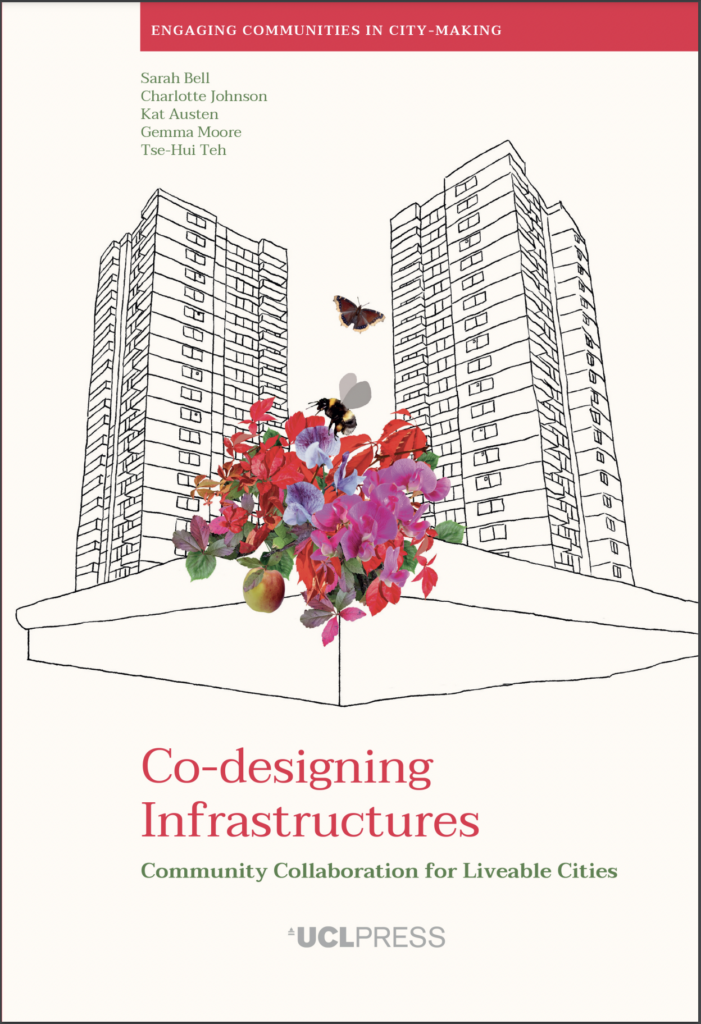
Co-designing Infrastructures is a useful provocation for museum professionals seeking to evolve their exhibition co-production models.
The book, which is co-written by five authors, is targeted at community organisers, engineers, designers and researchers, but its themes will chime with creative producers of collaborative projects.
It outlines the strengths and weaknesses of tried and tested methods of how to co-design solutions to complex social and environmental problems at the micro and macro levels, with tips on how to succeed.
I found myself immersed in a story of an ambitious research programme that sought to put the power of engineering and technology into the hands of grassroots communities. These initiatives have spurred bottom-up solutions to global crises through urban change.
The book documents four London projects that have co-designed solutions to systemic urban problems, such as tackling air pollution, housing, water management and the water-energy-food nexus.
It appraises the tools used to deliver these projects, and offers guidance for those delivering local solutions to social and environmental problems worldwide.
Case studies are brought to life through the authentic voices of community collaborators, who share their aspirations and frustrations around the project process and delivery.
These anecdotes are rigorously underpinned by theories of participation, environmental politics and socio-technical systems. The authors make a convincing case that a place-based approach to infrastructure is of international relevance as a foundation for urban resilience and sustainability.
£25, UCL Press
Free e-book
ISBN 978-1800-082229
The writers adopt a third-person style of co-authorship that is accessible. The inter- disciplinary ensemble of the contributors is impressive.
The co-authors are Sarah Bell, city of Melbourne chair in urban resilience and innovation at the University of Melbourne and visiting professor in environmental engineering at University College London (UCL); Charlotte Johnson, head of research programmes at the Centre for Sustainable Energy and a senior research fellow at UCL; Kat Austen, a socially engaged artist whose work explores how to move towards an environmentally just future; Gemma Moore, a senior research fellow at UCL’s Institute for Environmental Design and Engineering; and Tse-Hui Teh, a lecturer in urban design and planning at the Bartlett School of Planning.
The book sheds some light on the nuances between buzzwords used to personify modes of community collaboration. But it would be helpful to elucidate the distinguishing factors between “co-production”, “co-creation” and“co-design”. as such terms are often used and abused interchangeably.
While the book champions “co-design”, I notice the Creative Health sphere favours “co-production” above “co-design” when it comes to scoping social prescribing programmes.
In this more interactive and iterative context, harnessing the “lived experience” of community members in relation to the project theme, with adequate compensation for their time, is paramount.
At the bottom of the “ladder of participation” are public consultation activities that solicit passive feedback to inform institutional decision-making, but without forging obligations to follow up. Sound familiar?
How museum “co-curation” fits in this burgeoning ecosystem of community collaboration remains a conundrum that warrants further attention.
I was left pondering to what extent the asserted tools and principles could be applied to capital projects. Museums are starting to show that it’s possible to redevelop and construct new galleries through community co-curation.
Perhaps in future, with the right bespoke collaborative models, we might see genuinely co-produced museums, built and co-conceived from scratch.
Yasmin Khan is director of Covalent Creatives. X: @YasminCurates