Every five years, the international Progress in International Reading Literacy Study (PIRLS) provides an assessment of how well grade 4 learners around the world read for meaning. And every time South Africa participates, the results are shocking. In the 2021 survey, more than 80% of South African fourth-graders weren’t able to make sense of what they were reading in the test.
Policymakers have focused attention on developing literacy in the foundation phase (grades 1-3), because the skills developed during these early years will form the basis for learning in the higher grades.
But that’s not the only way to approach reading.
In addition to school literacy and reading to learn, children need opportunities to read for pleasure and enjoyment. If children’s school experiences of reading only involve chanting together, or reading aloud for an oral mark, or reading a text for a comprehension test, then they are missing the pleasure of delving into a story.
To be fair, teachers have to follow the national curriculum. Some also lack reading material. According to a 2023 report by South Africa’s Department of Basic Education, 75% of public schools do not have libraries, and where there are libraries, many are not well stocked.
If learners do not have access to a variety of texts, then they cannot develop reading “muscles”.
Resources that can be read and shared include newspapers, magazines, cartoons, online news and stories, posters, advertisements and packaging. As well as books.
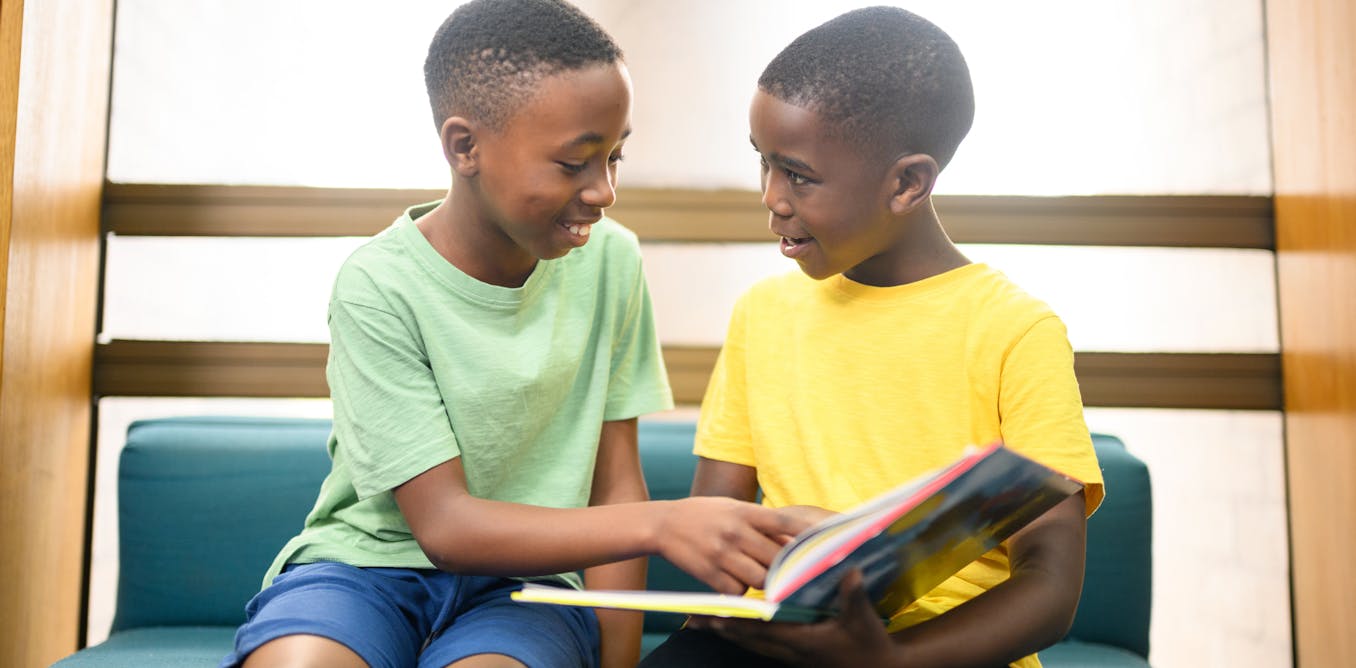
Whatever the reading material, learners need to have opportunities to develop their own response, at any level, and share their understandings. This can happen through a classroom reading club: a space for children to talk among themselves about what they have read purely for pleasure. Through talking, children begin to develop a critical voice and begin to capture their thinking in a more concrete form to share with their friends.
As someone who studies literacy development, I wanted to learn more about how children in poorly resourced South African settings can benefit from reading clubs. I did a study of grade 8 learners in reading clubs at their school, to understand their interactions with books and each other in small groups.
What emerged from my observations was the diversity of learner voices talking to each other about books. By being shared, their ideas were extended, refined and challenged. The children’s understanding grew on each other’s contributions. Talking showed what they were thinking and what their interpretations were based on. Talking to their peers was also a safe space to offer tentative responses that were not evaluated for assessment but a stepping stone in appreciation.
The reading clubs looked like a useful and fun way to build reading comprehension – something other schools can try too. I’ve suggested some tips below.
Talking about books
The school in my study had learners from a variety of language backgrounds. They had chosen to be in the English home language class, though many didn’t speak English at home. The school had few facilities, large classes, no functioning library and no set of books for the grade 8 class to read.
Over six months, I followed one class of 40 learners who formed groups of five for their reading clubs. They were given books to read at home and then took part in weekly discussions about the books. There were no set roles, format or questions for the discussions. The children could choose what they wanted to say to each other about the books.
Some of them had never read a book before.
Their discussions showed that they valued each other’s contributions and helped each other develop understanding and make connections. They also seemed to draw on what they had learnt before.
How to set up a reading club
My study supports the idea that reading clubs need:
Choices are motivating. Allowing learners in groups to decide what text they want to read gives them some say in the reading process. Teachers should allow a space in the timetable for learners to read and discuss what they have read, and share their understandings. Children like to talk about what they have read, and this helps them make sense of the story or article. Talking to each other in groups is less threatening than presenting to the class. Teachers could introduce some structure but ideally this is a time for learners to share freely. It also allows them to develop their own voice in response to texts and not worry about the “right” answer.
Teachers and parents
Teachers and parents need to model and motivate reading. Teachers could show the class a novel they are reading themselves and discuss the cover and title. Or the teacher might discuss the setting: not just a geographical place but also a place in time and what life might have been like there and then. Teachers could also spend a few minutes talking about a “main character”, what the reader learns about the character and what challenges the character might encounter.
Read more:
South Africa’s reading crisis: 5 steps to address children’s literacy struggles
Parents could ask children about what they are reading, what they like about the story, what they might change about it. Or ask them to share an exciting or interesting part and read it to the family for them all to enjoy. Just get them talking about any reading that is happening. Parents can share what they read online or in the newspaper so that talking about reading becomes a shared family practice.
If teachers want their learners to develop as readers, they need to be willing to give up some control. Learners need to be able to stop reading if they are not enjoying the text. They also might need longer than a week to read it.
Talking in groups, in school or at home, can be a time to share understanding and enjoyment, making sense of texts together.