It’s time for the little ones to slow down after the recent long holiday weekend with picture books that are fun and teach a few lessons, although the smalls won’t realize they are learning.
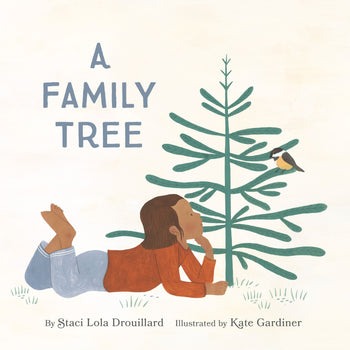
“A Family Tree”: by Staci Lola Drouillard, illustrated by Kate Gardiner (Clarion Books, $19.99 on book jacket; $15.99 on publisher’s website)
What a beautiful and important book for children of all ethnicities. Drouillard, a descendant of the Grand Portage Band of Ojibwe, tells a tender story about a little girl who is the same age as a spruce tree sapling on her grandparents’ land:
“The tree, like Francis, grew slowly. While Francis learned to walk on two little feet, the spruce tree walked in her own way — stretching her roots out into the ground, where they talked to the roots of the other trees in the garden.”
Eventually Grandma and Grandpa grow too old to keep up their property and have to move. Francis worries that the new owners might not understand that trees talk to each other underground, or that mother trees help keep their little ones strong by feeding the saplings with their own roots. And so the family decides to take the young spruce with them to plant at Auntie’s home where the grandparents will live. Grandpa plants it facing North, its former home, and soon the little tree is taller than Francis. She decorates her friend with bright lights in winter, celebrating the family’s connection to the trees, rocks and water of far northern Minnesota.
In an author’s note Drouillard, who lives in Grand Marais, writes that the book is based on the true story of a tiny white spruce that once lived in Grand Portage and now puts out new buds every spring from the safety of her yard. She gives a brief summary of the history of the Ojibwe people and their connection to the land from which they were removed.
“For Ojibwe people, losing access to our traditional homelands is like losing one’s place in the cyclical world of natural things,” she writes. “But, like the little spruce tree, we continue to adapt and change while retaining the wisdom and knowledge of the forest, which was taught to us by our elders, who learned from those who came before them.”
Drouillard, who won a Minnesota Book Award for “Seven Aunts,” sprinkles words from the Ojibwemowin language in the story, with a glossary at the end. This is also a physically beautiful book, with Kate Gardiner’s clean-lined, contemporary artwork in subdued colors of nature that sometimes wrap around the text or complement one line on a page. Gardiner is a New England-based illustrator with Native roots.
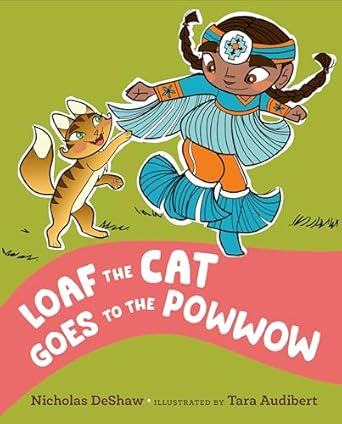
“Loaf the Cat Goes to the Powwow”: by Nicholas DeShaw, illustrated by Tara Audibert (Nancy Paulson Books, $18.99)
Loaf, the cat, loves living with “his boy.” One day, there was lots of ribbon around for him to pounce on: ” ‘This is my regalia, Loaf. I’m going to be a grass dancer at the powwow,’ my boy told me. He began to jump and spin around.”
Loaf senses there is something big going on in his boy’s life, and when the family leaves he jumps out a window and follows them to the powwow grounds. He watches the Grand Entry, hears the honor song for veterans accompanied by the host drum, and is proud when his boy is welcomed as the newest grass dancer: “The ribbons that I like moved with him so fast!/It was so good! I loved to see him!”
In the end, the boy and the purring cat snuggle down and take a nap.
This is the debut picture book from DeShaw, who lives in St. Paul. An Anishinaabe, he is a father, educator and traditional lacrosse coach. Illustrator Audibert, of Native and French lineage, enhances the light-hearted text with endearing characters with huge eyes and mouths. And Loaf does look exactly look like a loaf of brown bread.

“Quiet Violet Finds Her Voice”: by Gabrielle Nidus, illustrated by Stephanie Dehennin (Free Spirit Publishing, $18.99)
Violet likes to blend in so nobody at school notices her. But she’s confident in the kitchen, which is lucky because when a hands-on lesson about measurement goes haywire, Violet is the only one who can save a celebrated chef from an awful encounter with a very salty cookie. The author lives in Houston, and the illustrator in the Flemish countryside. Their book is part of Minneapolis-based Free Spirit Publishing’s 19 mental health kindergarten, first/second-grade series by different authors.
“Birth of the Bicycle: A Bumpy History of the Bicycle in America 1819-1900”: by Sarah Nelson, illustrated by Iacopo Bruno (Candlewick Press, $18.99)

This lively book begins with wooden velocipedes of the 1800s and concludes with the sleek machines that today have their own dedicated lanes in some cities, including St. Paul and Minneapolis. The author traces the bike’s journey from a luxury for the wealthy to a necessity for the working class. Illustrations are wonderful, from the top-hatted gentlemen riding bikes with big front wheels in 1819 to the 1868 carnival act with men balancing bikes on the high wire and the first fashionable garments for bicycle-riding women.
Sarah Nelson writes children’s books in prose and poetry, including “Frogness” and “A Park Connects Us,” inspired by St. Paul’s Lake Como. Bruno is an Italian graphic designer whose illustrations for “Birth of the Bicycle” capture the past.