The Gist
- Statistical insight. Call center statistics reveal that phone calls remain the top method for customer service interaction.
- AI uptake. Automation and AI technologies in call centers are projected to significantly increase over the next 5-10 years.
- Omnichannel expectation. Customers now demand quick, seamless service across all communication platforms.
Editor’s Note: This article has been updated on April 3, 2024 to include new data and information. The original content was authored by Shane O’Neill.
Call centers are a brand’s hub for customer service issues and are crucial to running a successful company. Utilizing call center statistics is essential for crafting effective customer support strategies.
Yet the word “call” may be a misnomer in our digital world. While most people still prefer the immediacy of a customer service phone call, consumers can now reach brands through a variety of channels (i.e., omnichannel): phone calls, emails, text messages, social media messaging and online chatbots.

Regardless of channel, call center agents, analysts, managers and team leaders remain the gatekeepers for a brand’s relationships with customers. But they work in a space that is evolving rapidly with the rise of new call center performance metrics and AI-based technologies like chatbots and virtual assistants. Keeping abreast of call center research, benchmarks and trends is critical to understanding customer expectations and developing a consistent strategy.
With that said, here’s a rundown of recent call center statistics that are defining customer support in 2024 and beyond:
Top Call Center Statistics
Call centers form the backbone of modern customer service operations, serving as vital hubs for communication between businesses and consumers. Let’s take a look at some of the key call center statistics you should know about.
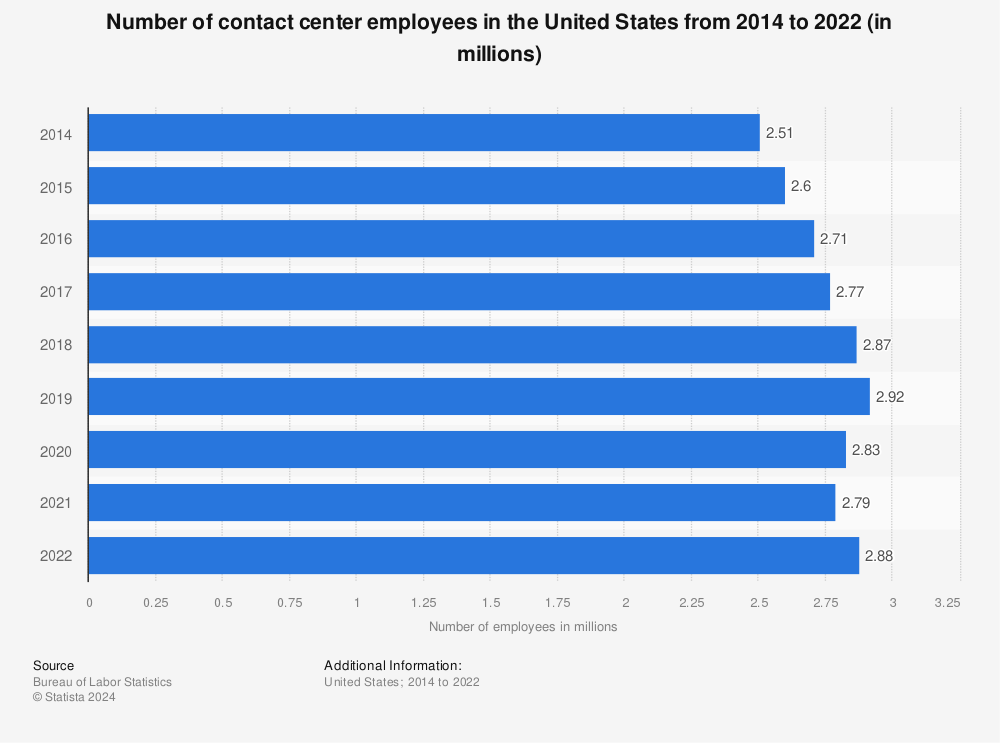
- The average call center handles 4,400 calls every month, with 48 missed calls. (Live Agent)
- 61% of call center leaders say call volumes have increased since the pandemic years of 2020 and 2021 despite the availability of self-service solutions for customers and AI-based tools like chatbots. (McKinsey)
- 71% of consumers expect companies to deliver personalized interactions, and 76% of them get frustrated when it doesn’t happen. (McKinsey)
- 62% of millennials and 75% of Gen-Z customers prefer self-service (subreddit, Google search or YouTube tutorials) almost all the time, even when they have an option of contacting customer support. This compares to 19% of baby boomers and 43% of Gen X customers who report they would do the same. (Gartner)
Related Article: Top Call Center Technology Trends
Call Center Performance Statistics
Call centers statistics can help when it comes to tracking operations, shedding light on efficiency, challenges and areas for improvement. Some of the top call center performance statistics include:
- Customer satisfaction score (CSAT): CSAT measures customer satisfaction with a service or experience through surveys and is considered the most important efficiency metric for call centers. CSAT scores vary by industry, but a good score is typically between 75% and 85%.

- Net promoter score (NPS): NPS gauges how likely it is for a person to recommend the company to others. A good NPS score is anything above 20%.
- First call resolution (FCR): FCR measures how often call centers can resolve a customer question or query on the first try. High-performing call centers achieve an FCR rate of 70% or higher.
- Average handle time (AHT): AHT is the average time it takes for a representative to handle a customer interaction, such as a phone call, email or chat session.The industry average AHT is a little over 6 minutes.
- Occupancy rate:Occupancy rate measures the percentage of time call center agents are directly dealing with customers. The recommended occupancy rate is between 85% and 90%.
- Average speed of answer (ASA): ASA represents the average time customers wait in the queue before their calls are answered. The target ASA is 28 seconds or less.
- Abandonment rate: A call abandonment rate indicates the percentage of callers who hang up before their call is answered. An abandonment rate of less than 5% is considered good for call center efficiency.
- Customer retention rate: Retention rate is the percentage of customers a business retains over a specific period of time. Average retention rates vary by industry, with a good customer retention rate falling between 55% and 84%.
The three most-used metrics to assess customer experience within the organization, including at call centers, are CSAT, NPS and customer retention rate, according to CMSWire’s State of Digital Customer Experience Report.
Related Article: 11 Top Customer Service Metrics to Measure
Call Center Future Trends Statistics
As technology continues to evolve, call centers are poised for transformative change. Let’s take a look at some important call center statistics focused on future trends, offering insights into the innovative strategies and technology driving customer satisfaction in the years to come.
- Currently, 49% of businesses polled said they use call center software or a call center knowledge base. However, that number will increase over the next two years, with 24% of organizations planning to adopt it. (CMSWire State of Digital Customer Experience Report)
- The rate of automation in agent communication with customers is projected to increase by 5x and reach approximately 10% of agent interactions by 2026, compared to 1.8% in 2022. (Gartner)
- Call centers are rapidly adopting AI technologies such as chatbots, virtual assistants, speech recognition, interactive voice response (IVR), natural language processing (NLP), predictive analytics and sentiment analysis. (MarketsandMarkets)
- The global AI market in the call center segment is currently worth $1.6 billion, but is expected to exceed $4 billion by 2027. (MarketsandMarkets)
- Expect an increase in adoption of AI-based voice assistants. More than 8 billion units of voice assistants will be in active use worldwide by 2024, which is double the number of voice assistants that were in use in 2020. (Statista)

- Omnichannel customer engagement will be the norm. Customers now expect agents to know their purchase history and handle requests quickly in all communication channels. As such, the omnichannel customer engagement market is forecast to grow 13% a year to reach almost $18 billion in revenue by 2030. (Grand View Research)
Build a Strategy Based on Call Center Statistics and Trends
While call center statistics and industry trends can be illuminating, they’re only useful if call center leaders can translate them into actionable strategies.
Brad Cleveland, keynote speaker, customer strategy consultant and author of “Leading the Customer Experience: How to Chart a Course and Deliver Outstanding Results” and other books, says an effective strategy should include the following 10 components.
- Customers – Who are your customers?
- Interactions – What kinds of interactions do they have with sales, customer service and/or tech support?
- Channels – How do customers reach service: phone, chat, text, self-service, in person?
- Hours – What hours are services available?
- Service level – How quickly can customers get help?
- Routing – How do you get the right customer to the right resources?
- People/technology – What people and what technology resources are required for each interaction?
- Information – What information will be required?
- Analysis and improvement – How are you learning from interactions to improve products, services and processes?
- Guidelines – What are your guidelines for deploying new services?
The strategy components above, combined with the call center statistics cited in this article, should give leaders a roadmap for identifying performance gaps and making adjustments where needed.
“Many organizations lack a clearly-defined call center strategy,” says Cleveland. “They tend to make decisions in a vacuum, which leads to inconsistencies and poor experiences. So when forming a strategy, I encourage teams to think about these 10 components together, and how AI and other developments could positively impact any of the components.”