
Book Review
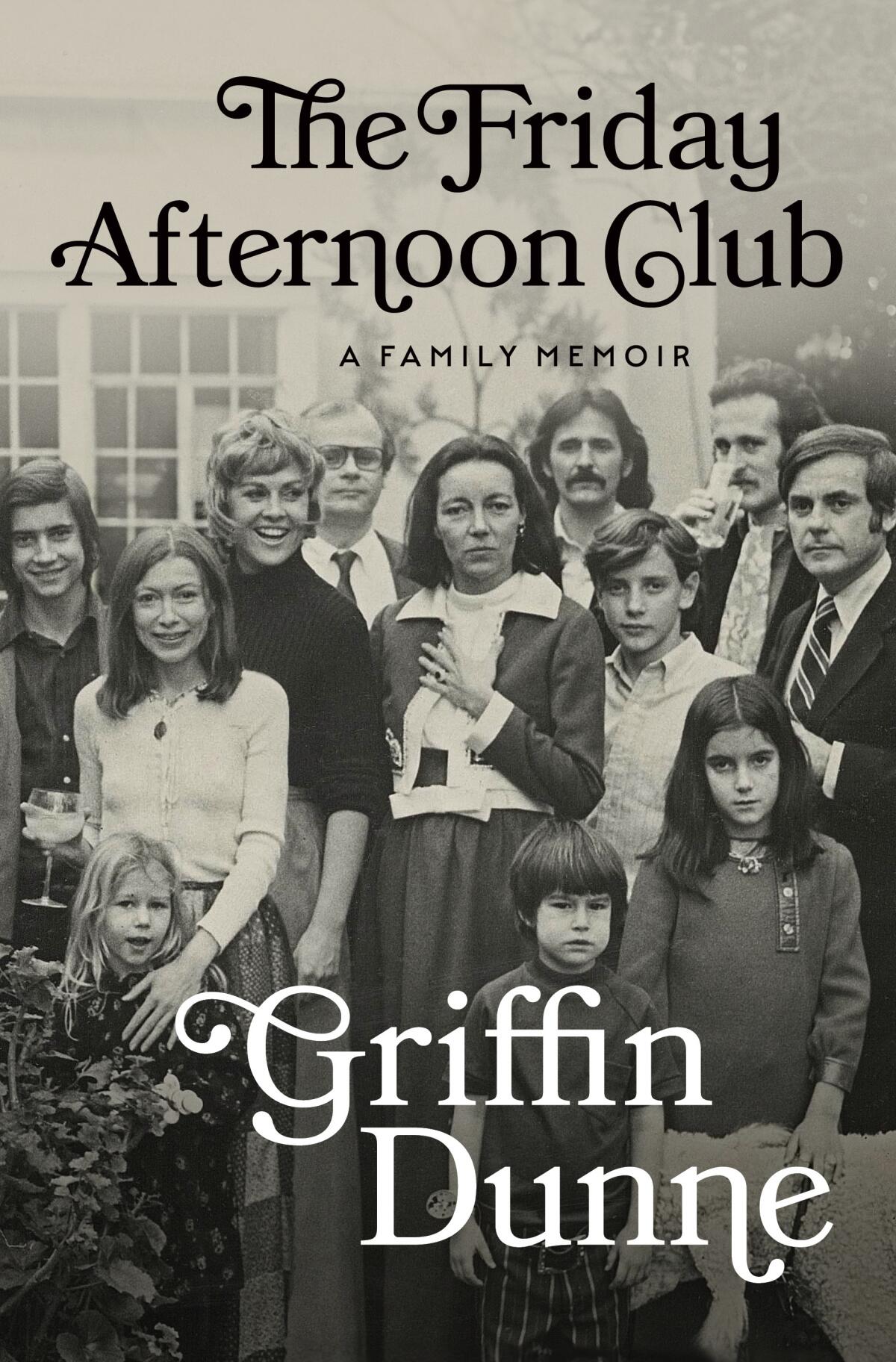
The Friday Afternoon Club: A Family Memoir
By Griffin Dunne
Penguin Press: 400 pages, $30
If you buy books linked on our site, The Times may earn a commission from Bookshop.org, whose fees support independent bookstores.
Life’s what you make it, especially when times are hard.
For example: It’s past midnight and you’ve come to SoHo to see a woman you met in a diner but she’s not everything she seemed and you can’t afford the subway home because your money flew out the taxi window on the ride downtown so you bum around but end up getting mistaken for a burglar and then the woman from the diner overdoses and before you know it you’re being chased by a mob of punks led by a vigilante driving a Mister Softee truck. But you still make it to work on time.
Sure, this is the story of Martin Scorsese’s dark screwball classic “After Hours,” but, based on his own testimony, it could as easily be a night in the life of the film’s lead actor, Griffin Dunne. In his new memoir, “The Friday Afternoon Club,” Dunne, who would be nominated for a Golden Globe for his performance, recalls first reading the script.
“By the tenth page the terrible things happening to the hero of the story made me so anxious I couldn’t read sitting down,” he writes. “I was perfect for the role. The misadventures of Paul Hackett, the main character, could only have happened to me.”
Another title for “The Friday Afternoon Club” might indeed have been “The Misadventures of Griffin Dunne.” In the course of the book, which focuses mainly on the first 35 years of his life, he’s “flogged and fondled” (boarding school), humiliated (frequently), almost killed in a street brawl, fired, arrested, labeled a “second-rate Dudley Moore” by Pauline Kael and molested by a handsy Tennessee Williams.
Dunne largely bears these slings and arrows with good humor and equanimity, conscious, perhaps, that in retelling them he becomes the hero of the joke. He gets terrific mileage from his own bad luck.
There’s good fortune, too. Dunne grew up privileged in the freewheeling Hollywood of the 1960s and ’70s, the eldest of three kids.
His parents, Lenny and Dominick Dunne, and aunt and uncle, the writers Joan Didion and John Gregory Dunne, enjoyed starry social lives. Guests at one party included Truman Capote, Natalie Wood and Tuesday Weld. Sean Connery saved him from drowning. Elizabeth Montgomery, later Samantha in “Bewitched,” baby-sat him.
Later, his best friend and sometime roommate in New York was Carrie Fisher (Debbie Reynolds paid the rent). In one chapter, Fisher contrives to lose her virginity to our hero, who it turns out is something of a Don Juan type. “Falling for girls was what I did for a living, pro bono,” he writes.
But for all that, “The Friday Afternoon Club” is haunted at its core by a dreadful family tragedy.
The worst night of the Dunnes’ lives plays out twice in the book. In a brief prologue, we read about the night in late 1982 when a homicide detective knocked on the door of Lenny Dunne’s L.A. home with the news that her daughter, Dominique, had been strangled and was in intensive care. Griffin, then 27, could still taste the previous night’s cocaine in his throat when his father called to tell him.
This night hangs over hundreds of pages of family history and childhood memory before Dunne returns to the story. The death of Dominique, a rising star through her role in that year’s hit movie “Poltergeist,” and the trial of her ex-boyfriend John Sweeney are the subject of the book’s devastating final act.
What makes these unimaginable events so readable, and allows Dunne to find a kind of grace even amid tragedy, are his unshakable black humor and unfailing nose for a good story.
Perhaps the ability to mine the worst experiences for good copy was inherited. After all, Dominick Dunne’s late-in-life success as a journalist began with his blockbuster account, in Vanity Fair, of Sweeney’s trial. Griffin was initially ambivalent toward the piece, doubtful of his father’s motives and feeling that the family’s grief was not for public view, but he concedes that it would later become “a bible I’d share with anyone I thought might become part of my life.”
Indeed, it’s possible Griffin’s account of those terrible days was shaped in part by Dominick’s; numerous details recall the Vanity Fair essay, and father and son seem to share a wary appreciation of the black comedy of fate. Both find grim humor, for instance, in the disaster of Dominique’s funeral, bungled by a pickled monsignor who double-booked it with a wedding.
“When the chauffeur opened the door for us to get out,” writes Dominick, “a hot gust of wind blew multicolored wedding confetti into the car.” Griffin continues: “As Dominique was being lowered into the ground, a tour bus let out sightseers in front of Marilyn Monroe’s columbarium.”
One might also detect the influence of Aunt Joan, especially in Dunne’s levelheadedness and strong eye for material, however painful.
In “The Center Will Not Hold,” the invaluable Netflix documentary he made about Didion in 2017, he asks what it was like watching a 5-year-old girl tripping on LSD, an incident she wrote about in “Slouching Towards Bethlehem.” After a pause, Didion says, “Let me tell you, it was gold.” Dunne, too, is a prospector for the incandescent detail.
Ultimately, Dunne shows the power of writing and temperament to transform the central tragedy in his life into much more than just a tale of suffering.
As with his character in “After Hours,” there are certainly moments when he might have thrown up his arms and screamed “What do you want from me?” Instead, he finds solace in Dominique’s memory long after she’s gone.
She becomes a kind of guardian angel; he feels her presence in the book’s peaceful final pages, as he happily holds his firstborn daughter. Even the title of his memoir is Dominique’s — the Friday Afternoon Club being a short-lived but fondly remembered weekly get-together with her acting classmates.
It’s the sort of detail that, in retrospect, lends life the richness that makes it worth enduring and celebrating, despite everything.
Charles Arrowsmith is based in New York and writes about books, films and music.