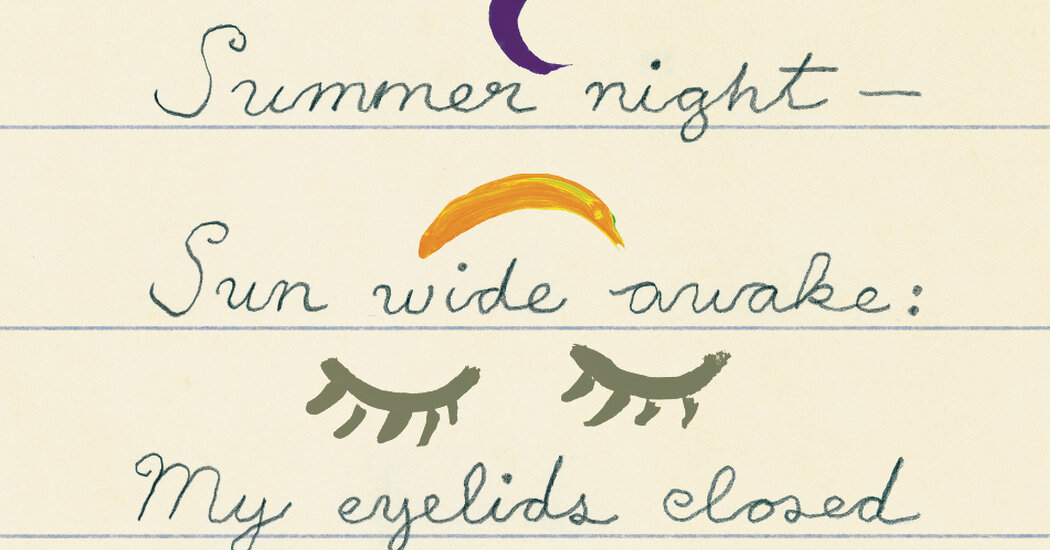
LITTLE POEMS (Everyman’s Library, $18), a new anthology edited by Michael Hennessy, provides a history of short poems since antiquity, from Sappho to Ocean Vuong, a lovely pocket-size volume with several hundred brief, chronological examples of what poetry can do. I read it cover to cover, speeding through the centuries, though approaching an anthology this way, for anyone other than a critic, is perverse. The pleasure of anthologies is scope, scope and openness. As with Wikipedia or the O.E.D., you can enter anywhere and stop any time. They encourage random flipping and riffling, seeing what hooks the eye — a form of bibliomancy, this mode of intentional happenstance. Dipping into “Little Poems” like so, you might find, in rapid succession, a fifth-century epigram by Julian the Egyptian (“I kept singing this, and I will call it out from the grave:/‘Drink, before you put on these clothes of dust’”) and “This Living Hand,” by John Keats, another poem that projects itself into a time after death, ever startling in its moment that sounds like someone talking right now, right next to you: “So in my veins red life might stream again,/And thou be conscious-calmed — see here it is —/I hold it towards you.” You might find a handful of snail poems, or anonymous poems, which, when they appear back to back, as do “Western Wind” (“Westron wind, when will thou blow?/The small rain down can rain”) and “Hey Nonny No” (“Is’t not fine to dance and sing/When the bells of death do ring? … When the winds do blow,/And the seas do flow?/Hey nonny no!”), you can pretend were written by the same famous, nameless poet.
I have a friend who says her favorite way to read poetry is in quotation, as isolated lines in paragraphs of prose, such as in this column. I’ve come to many poems I love in similar ways, hearing a fragment of someone’s offhand recitation. I sometimes think poetry is best caught in snatches, like snippets of song from a passing car. In “The Hatred of Poetry,” Ben Lerner describes the way “actual poems” disappoint us, unable to fulfill their “transcendent” promise: “The infinite is compromised by the finitude of its terms.” The partial poem escapes this fate. The parts out of view, off the page or just nowhere, the bracketed nothing in Sappho, can remain transcendent — not better in imagination, but better unimagined.
A too-short poem can ruin this effect, the effect of out-of-context-ness. When there is poem-out-of-view, you feel lucky, as if you might have found the bit that matters only to you. There is nothing out of view in the fishhook poem; you see it all at once, and everyone sees the same thing. You can’t have a personal, favorite part, the way I have a favorite part of “Prufrock” (which changes over time).
Some of what’s in “Little Poems” does have a one-and-done feel. There’s plenty of silly, light verse, not that I always mind throwaway poems (potato soup!). Short poems can be facile because they are short — they’re not wasting much of your time, so get over it. I almost prefer the really inane poems, like “The Toucan,” by Shel Silverstein (“What kind of goo can/Stick you to the toucan?/Glue can”), to something like “This Is Just to Say.” The plums in the icebox have gained new life as a meme, but I don’t ever need to read the poem itself again. It’s unsatisfying in the way of all short unsatisfying poems; the end of any poem is a reward, but bad short poems satisfy too soon. There are no hidden corners, no places to get lost in and surprised. (This may be a personal failing, but I have never read any translation of Basho’s haiku about the frog jumping into the pond without thinking, So what?)
It’s hard to create mystery in just a few lines, but not at all impossible, and many poems here are delightfully baffling, like “The Gazelle Calf,” by D.H. Lawrence: “The gazelle calf, O my children,/goes behind its mother across the desert,/goes behind its mother on blithe bare foot/requiring no shoes, O my children!” I have no idea what significance this image had for Lawrence — he seems moved and upset by the calf for reasons left outside the poem, which functions like a sigil in chaos magic: a wish condensed to a symbol sufficiently removed from the wish such that you can forget what it was, then pursue it without conscious desire.