
Dear readers,
A few years ago I interviewed a writer who in a past life worked as a transcriber for people who had suffered traumatic brain injuries. Listening over and over to patients describe life-changing pain, she realized their realities bordered on the supernatural, and that adopting language more commonly found in science fiction or fantasy was the most honest way to convey their distress.
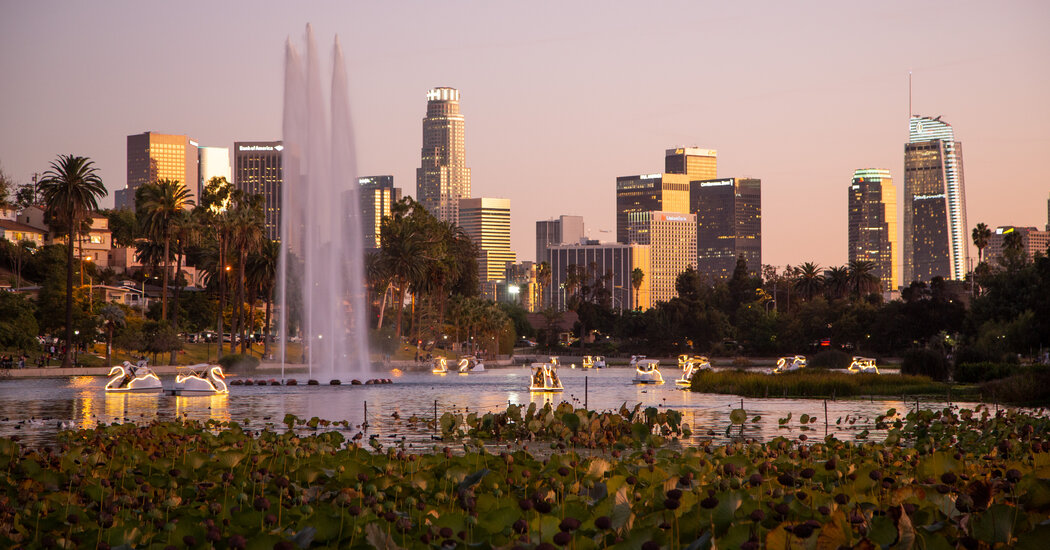
I thought of her earlier this summer, around the time I realized my knowledge of the Los Angeles literary canon was basically nonexistent. It was stupid I’d never thought to approach the city — which despite my years of visiting family there has never felt like terra firma — through novels. The books I recommend today are both set in the region, but that’s almost incidental. More important: They convey a sense of place that had previously eluded me, using fantastical, intentionally stylistic language, and somehow rank among the truest things I’ve read.
—Joumana
This unsung stunner could credibly be called “pre-gentrification noir” — two words I wouldn’t normally put in the same room together, let alone the same clause.
And it’s great. Joe, a writer for hire “at the wrong end of Sunset Boulevard,” mostly types up résumés for locals and outrageously purple letters to women in mail-order bride catalogs. We traipse through Echo Park and see it through his crusted-over affection. “The leaves in the trees were putting on a show,” he observes early in the book. “Plus all those young couples, hand-in-hand. More than buds were swelling.” Then, a cold splash of reality: “I dropped my corncob in the gutter for some dog to finish off.”
By way of plot, there’s not much. Steady yourself for a troubling bit of pornographic correspondence with “Natasha,” a frisky overseas pen pal who finds erotic inspiration in … cows? Joe is chided by a snooty restaurant manager for eating street food from a Latino vendor (“Who else is going to sell me roast corn?” he counters, reasonably) and stumbles into a demented birthday celebration thrown by a local eccentric. Mostly he pingpongs around, frets about his empty wallet and guzzles coffee in the beauty salon next to his office.
A note about Stromme, who died in 2006: A longtime resident of Echo Park herself, she also lived in France for years, was described by The Los Angeles Times as “a gardening columnist with a political bent” and published a thriller (“Against the Grain”) about a deadly conspiracy involving — what else? — seeds.
Has anyone ever sounded cooler?
Like her evil-agribusiness debut, “Joe’s Word” was initially released in France, by the same publisher that put out French editions of Raymond Chandler and Dashiell Hammett. Merci, City Lights, for bringing this one out in its mother tongue.
Read if you like: Joe Ide, haggling, Gilberto Freyre
Available from: Direct from City Lights, or from an Echo Park sidewalk sale if you’re lucky
“Tropic of Orange,” by Karen Tei Yamashita
Fiction, 1997
In the type of coincidence possible only in the R.L.T.W.E.L.U. (Read Like the Wind Extended Literary Universe), two colleagues have recently pointed me toward books by Yamashita, who was not previously on my radar. One of those recommendations came by way of R.L.T.W. itself — Sadie Stein heartily endorsed “I Hotel” in these pages a few months back. Now I’m here to flog Yamashita’s dervishlike, magical realist novel of Southern California.
The story follows seven characters, though if there’s an anchor, it’s Gabriel, a Chicano reporter in Los Angeles slowly building a home in Mexico. The Tropic of Cancer crosses his property, which he finds poetic (Gabriel is a romantic, which is not true of most journalists I know). To commemorate this auspicious, invisible boundary, he marked it with an orange tree. But when a fruit from it is moved from Mexico to California, the latitude is dragged along with it, causing all sorts of disruption.
Fires menace Los Angeles, as do climate change, black market organ vendors, an omnipresent sun. Still, Yamashita plants moments of poignancy (a former surgeon, now homeless, “conducts” symphonies on the freeway) and grim humor, enough to keep you bobbing along in the narrative.
When the highway system comes to a halt — urban thrombosis — an exodus of people leave behind their cars and start walking. It’s unsettling, DeLilloesque; you brace for even more depravity when you encounter terror “reflected in the faces of people huddled in a dark van.” Turns out, that fear was actually caused by their “attentively listening to all 24 90-minute cassettes of a Stephen King novel narrated for Books-on-Tape.” Funny!
Not every voice in the book is successful; one character’s narration consistently claps on the one and the three. But it’s a romp to watch Gabriel and his girlfriend roast each other, lovingly, as the city teeters on collapse, and I can get down with the story’s magical fruit, portentous crabs-as-omens and other fantastical elements.
Read if you like: The “Redwall” series (seriously), “Something New Under the Sun,” by Alexandra Kleeman, Greta Gerwig’s wig in “White Noise”
Available from: Good used-book stores or libraries, or from Coffee House Press in a 20th-anniversary reissue
Why don’t you …
-
Hop into a Dodge pickup with the unparalleled L.A. restaurant critic Jonathan Gold, by way of his standout collection “Counter Intelligence”?
-
On the subject of intuitive, sensitive eating: Dine with Aimee Bender’s 9-year-old supertaster, who can detect emotions in her food?
-
Revisit a classic ur-novel of Los Angeles, John Fante’s “Ask the Dust”?
Thank you for being a subscriber
Plunge further into books at The New York Times or our reading recommendations.
If you’re enjoying what you’re reading, please consider recommending it to others. They can sign up here. Browse all of our subscriber-only newsletters here.
Friendly reminder: check your local library for books! Many libraries allow you to reserve copies online.