
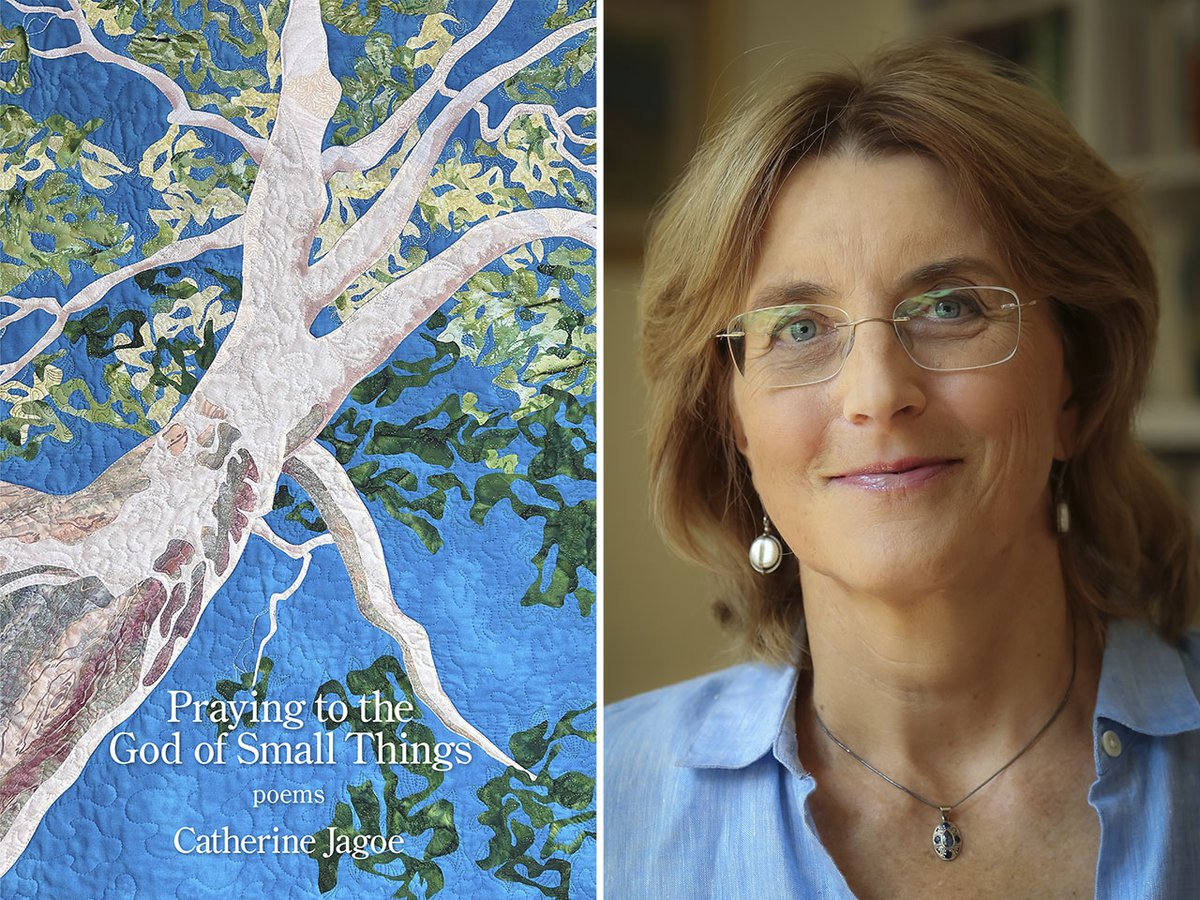
Madison poet and essayist Catherine Jagoe has been writing poetry since she was 8, when, she says, a poem woke her up and she had to write it down.
Jagoe was born in Britain and spent part of her early childhood in Nigeria; she’s also lived in France and Spain doing research when she was an academic (she has a Ph.D. in Spanish literature and is also a translator). But her latest book, Praying to the God of Small Things (Kelsay Books), is rooted largely in the Midwestern landscape.
While every poem in this collection has a connection with nature, the effect is far from ecstatic. Nature, long a provider of solace and joy in the tradition of pastoral poetry — “A beautiful, innocent place of redemption,” says Jagoe — is now a worry. The threat of climate change hovers over these poems.
Jagoe says Praying to the God of Small Things grew out of two things: “tremendous climate anxiety” and the arrival of the COVID-19 pandemic: “Confined to home, small things became very important. And literally, tiny viruses were ruining lives.” Jagoe started paying more attention to her “home terrain, when and how things were growing.” Accompanying a photographer friend, she discovered the small insects he photographed, “so tiny they’re hard to even see, amazingly beautiful, and I started to see them myself.” A selection of insect poems and photos forms the middle section of the book.
Jagoe incorporates several unusual poetic forms. Her poem “Aldo Leopold’s ‘On a Monument to the Pigeon’: An Erasure” takes text from Leopold’s essay about the disappearance of the passenger pigeon and “erases” much of it, finding or carving out the poem from within the already extant words. “Acorn Weevil” is lineated to create the shape of an acorn. And the clever “Leafhopper” intersperses lyric description with a found poem in the form of Google search phrases.
Paying attention to one’s surroundings is a recurring theme. “As a poet, your main job is to notice, and to help others see,” says Jagoe. This can range from human noises (“the braat braat of nailgun” at a house under construction) to the sound of cicadas (“the very air was singing like the sea”). These are both part of nature, Jagoe notes. “We are nature. I heard a quote recently that nature isn’t a place you can drive to. It’s everything.” Ultimately “we can’t save what we don’t know exists.”
The poems are “an act of witness to this moment that we are in, that is grief and hope and wonder all at once,” says Jagoe, and — idealistically — they may “spark something in people to start making different choices.”
The book launch for Praying to the God of Small Things is July 7 at 2 p.m.; anyone wanting to attend should email Jagoe through her website, catherinejagoe.com. She will also be reading and in discussion with Madison poet and environmental essayist Heather Swan Aug. 28 at 6 p.m. at Mystery to Me bookstore.