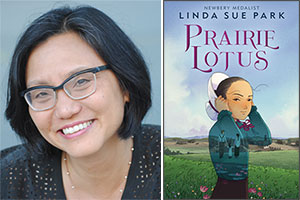
In her 20-plus years of writing books for children, Newbery Medalist Linda Sue Park has delved into a broad range of formats and genres, from picture books to historical fiction to poetry. Her new book, Prairie Lotus, takes a fresh look at the American West in the second half of the 19th century. Park spoke with PW about her love for—and eventual discomfort with—Laura Ingalls Wilder’s classic books about that era, and her own need, when creating historical fiction, to write about “who else was there?”
You write in your author’s note for Prairie Lotus that this book is “a story I have been writing all my life”—but when and why did you decide to tell this particular story?
In some ways, it was a kind of perfect storm: I had this story in my head for a long time, but the questions I’d been asking myself came into sharp relief a few years ago when the conversations began about equity and inclusion in children’s literature that brought about the creation of We Need Diverse Books in 2014. Since then, I was able to do a lot more learning about these issues, and finally came to feel I had a way into this story. The book was in the editorial process in 2018 when the ALA’s Laura Ingalls Wilder Award for lifetime achievement in children’s books was renamed the Children’s Literature Legacy Award. There was a noisy discussion about changing the name because of the dated cultural attitudes in Wilder’s work, and I began to feel, “Okay, this book will not be published into a great yawning void.”
You also write about fantasizing, as a girl, about being in De Smet with Laura in the 1880s. How much of that made its way into Prairie Lotus?
Hanna’s story was all there from my childhood imaginings, from when I was a tween. I used to imagine I was Laura’s best friend; Laura was having a romance with Almanzo and I was having a romance with his best friend, Cap Garland. I had loved the Little House stories so much that I needed to know if there was a way I could have been in them. Somehow I had learned that while the first Koreans to come to America hadn’t arrived in Hawaii until the early 1900s, thousands of Chinese immigrants had come much earlier, during the Gold Rush, and helped build the transcontinental railroad. I knew there were Chinese people living in what was then Dakota Territory by the 1870s. So in my imagination, I became a Chinese/Korean girl living in De Smet.
An appealing aspect of the book is Hanna’s love of, and skill at, dressmaking and all those details of fabrics, trims, buttons, and patterns. Why did you choose dressmaking as Hanna and her mother’s particular skill?
I chose it for several reasons. First, I love the specific places where dressmaking appears in Wilder’s books. There are many parts of Prairie Lotus that I think of as being “in conversation” with the Wilder books, and that is one of them. Also, my mother and grandmother were very good seamstresses—though I am not—and including dressmaking in the book is a way of honoring them. Then, there is the stereotype of the Chinese laundry in American culture—the Chinese involvement in textiles—and I wanted to turn that stereotype on its head. Finally, I’m very interested in endeavors that involve the head and the hands, like the textile arts, for example. They are so unlike writing, which is all in the head.
Your depiction of the Ihanktonwan women and children Hanna encounters has been noted as being nuanced and respectful. You write in your author’s note about the extensive research you did for these few scenes. Can you talk about creating those scenes?
I strongly wanted to present a different view of Native Americans than Wilder did. When you’re writing characters who don’t share your identity markers, it’s important to start with humility and respect. You don’t know what you don’t know. I felt it was important to include some of the actual Dakota language because in many books that include Native Americans, readers wouldn’t even know they had their own language. Too often, the people are depicted as grunting or speaking pidgin.
And then, in all my books, I fully imagine a back story for the secondary characters. One of my favorite books for researching Prairie Lotus was Buffalo Bird Woman’s Garden [Minnesota Historical Society], an oral history by a Hidatsa woman born in 1839 that was told to an anthropologist. Her voice has, of course, been translated, but the translation seems very respectful. She farmed in what is now North Dakota and innovated many gardening and farming techniques. Her accounts helped me build the character of Wichapiwin.
When starting a book of historical fiction, I usually ask, “Who else was there?” Not just the culturally dominant people, but who else? I think of Chimamanda Ngozi Adichie’s TED Talk about “The Danger of a Single Story,” in which she discusses how having an incomplete story means you have a story that’s not true. An incomplete story is a false story. Almost all the stories of the American West have that problem. In writing Prairie Lotus, I wanted to make this part of American history a little more complete. The essence of Prairie Lotus is: “Who else was there?”
In your 30 or so novels and picture books, you’ve written across centuries and across cultures, including taking on the voice of a Catholic girl in working-class Brooklyn in the 1950s in Keeping Score. What comes first for you, historical era, geographical location, or character?
Every book begins differently. With Keeping Score, I wanted to write about the Korean War and about baseball. The 1950s were the golden age of baseball; the sport had just been integrated. And I have always loved baseball—I had a crush on Willie Mays when I was young.
I have written several historical novels about Korea: Seesaw Girl, The Kite Fighters, and A Single Shard, plus When My Name Was Keoko. The first three are set in medieval Korea, and Keoko is based on my parents’ childhoods. Regrettably, I don’t read or speak Korean, which means that, other than my parents’ stories, I would not be comfortable writing about more recent history—I wouldn’t be able to do the necessary research. As you go back further in time, the resources get sparser, so in writing about 12th-century Korea, I felt freer to use my imagination. For the same reason, I chose to write Keeping Score from the point of view of a girl living in the U.S. during the Korean War years. She learns about the war through newspapers and newsreels, records that I could access in English.
A Long Walk to Water was a gift dropped into my lap through my husband’s work as a journalist. He met and wrote about Salva Dut and eventually introduced us. It was serendipity, getting to know Salva. If I had my way, his name would have been on the cover, but there were reasons he didn’t want his name on the cover. The only thing that’s invented in that book is the dialogue.
In Project Mulberry, the main character has an ongoing conversation with the author. How did you decide to include that in the book?
Because I won the Newbery [for A Single Shard] I was in the very fortunate position of doing many school visits. I was asked many questions to which I didn’t have the answers, such as “how do you develop a character?” Like many writers whose writing comes out of being voracious readers, I was just trying to make characters as real as those I loved. But it’s very unsatisfactory for an author to say “I don’t know” to a question like that, so I had to do a lot of thinking about how I do it. And that thinking morphed, in Project Mulberry, into Julia talking to the author. Kids love this, but adults not so much. Adults have told me they feel Julia is not respectful when she’s talking to the author, but of course she’s just me talking to myself.
Your characters have very different voices, though each one sounds utterly authentic to their time and place. How do you create your characters’ voices?
People say voice is very mystical—“I just hear the character talking to me in my head,” “a voice just came to me”—but I believe writing is a craft, and like any craft it has its tools. Voice is made up of concrete elements—words, punctuation, sentence length—and those concrete elements are a writer’s tools. When I’m teaching children, I like to give them an exercise: write a sentence and then put it into the voices of different people in pop culture. How would the current resident of the White House say this? How would Cardi B say this? You would pick different words depending on who is talking. Also, people speak with different punctuation. Some people talk on and on in run-on sentences. Some speak with a lot of exclamation marks. Some teenagers speak in one-word sentences: “Yeah. Right.” When I’m working on a first draft, though, my primary concern is the story itself. For me, story is a character with a problem. I do try to create the character’s voice as I’m writing, but it’s definitely something I focus on more during revision.
What’s the difference in your approach toward the Wing and Claw fantasy series, for example, and a book of historical fiction like Prairie Lotus or A Single Shard? And what kind of challenges did you face with The 39 Clues books?
My writing is a byproduct of my reading. I’m a very eclectic reader. People ask me what my favorite genre is and I say “good.” I don’t have time to read a bad book. I’m lucky that when I started writing 20 years ago, my publisher Clarion let me write all over the place; there wasn’t the need to brand a writer the way it’s done now. And it was my wonderful editor Dinah Stevenson who let me do that. I didn’t start writing fiction until I was in my 30s. Before that, I had only written poetry. I’ve always been very grateful I spent all those years writing poetry. Poets look at every single word—even deciding if they need “the” and “a.” Picture books were a natural extension from my poetry. In picture books, you want as few words as possible because it’s a picture book, not a word book with pictures. I write and edit my fiction as though it were poetry. It’s not hard for me to cut.
As for The 39 Clues, the biggest challenge was I had never worked on a deadline. These books had a very short timeline and that was a dealbreaker until the editors found some more time for me—they gave me six to eight months. But it was easier because so much was already established: the characters, the location, etc. I was invited to be part of The 39 Clues because I had worked with the editors at Scholastic. [It was the best way of writing a series: I’d always wanted to, but I also didn’t want to. I love reading series and I know kids love them, but I didn’t want to have to sustain characters through numerous books.
What are you working on now?
I’m very excited about a picture book coming out in August 2020 [from Simon & Schuster]. It’s called Gurple and Preen and illustrated by Debbie Ridpath Ohi. Debbie uses a concept she invented called broken-crayon art, with the tagline, “You never know what will come out of a broken crayon.” Her art is like nothing you’ve ever seen. She asked me to write a story that would go with her broken-crayon art. It was an interesting challenge: I had to keep in mind lots of opportunities for broken crayons!
And in 2021 I have a poetry collection coming out from Clarion. It’s titled The One Thing You’d Save and it’s structured like a classroom discussion in which the teacher asks the children, “If there were a fire and all the people and animals were safe, what’s the one object you’d save?” Each child gets a poem for a response.
I wrote an earlier collection called Tap Dancing on the Roof [Clarion, 2015], which is a collection of sijo, a Korean form of poetry traditionally written as three lines of 13–17 syllables each, so the lines stretch all the way across the page. This can look odd to people accustomed to reading poetry in English, so sometimes the lines are broken in half, making six shorter lines, which looks more “poem-shaped.” There are stress and content ideals for each line, too. The poems in The One Thing You’d Save were written using the sijo line and stanza structure; however, many of them are longer than three lines. While they’re not traditional, I think of those poems as a modern way of honoring the form.
Are you currently working on anything longer?
No, because when I finish a novel it’s always the last novel I’ll ever write! It’s followed by a very fallow period. Prairie Lotus was an especially difficult book to write because the experiences of racism in it were ones that have happened to me, and it was very painful to write about them. So in this particularly long fallow period I’m concentrating on working on issues of equity and inclusion—what we’ve been calling diversity—for SCBWI [the Society of Children’s Book Writers and Illustrators] and WNDB. There’s a movement now away from the use of the word diversity. The word diversity actually means diverging from a standard—in this case, a standard of whiteness. So while it’s served its purpose, we’re now talking more about equity and inclusion. That’s where my focus is right now.
Prairie Lotus by Linda Sue Park. Clarion, $16.99 Mar. 3 ISBN 978-1-328-78150-5