
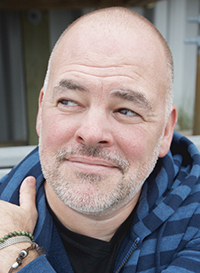
In the past six years, Matthew Quick has made a name for himself as a YA author to watch with his gripping novels investigating the adolescent psyche, including Sorta like a Rock Star, Forgive Me, Leonard Peacock, and Boy21. In addition to already being the bestselling adult author of The Silver Linings Playbook, which was made into an Oscar-winning film, Quick has written two other adult novels – The Good Luck of Right Now and Love May Fail (with another one on its way next year). This month he will publish his fourth YA novel, Every Exquisite Thing, in which high school senior, Nanette O’Hare, reads a life-changing novel that forces her to question everything about herself. PW spoke with Quick, a former teacher, and learned about the personal connections he has to his stories, reading and writing books about the anti-herd mentality, and his new role as a budding screenwriter.
I read that you were at first reluctant to write YA. Now that you’re four novels in, what would you say you’ve learned about the field and what do you now like about writing for this age level?
Writing for young people feels a lot like when I was teaching. They have a lot less baggage. They tend to be a little bit less jaded as readers, and I think as people, too. So I feel as though with my YA readers who are teenagers that if they like something, they like something because they like it, not because they are supposed to like it. I think adults have a tendency to want to be in with the herd, whether it’s academia or the literary elite or whatever. They want to like the right things, and I think that teens are eager to find the work or books that resonate with them strongly on a very personal level. I know it was for me when I was a teenager; none of my friends read books, so when I was reading it was a very solitary experience. It was all about what I was feeling and having this very intimate relationship with a book. So I like that about YA and writing YA. The fan mail that I get from teenagers is often, ironically, more thoughtful than the stuff I get from adults, because usually adults are very formal with their fan mail whereas teens are very informal. They’re unguarded, they’re ready to tackle ideas, and they’re still forming their worldview, so literature can be very revolutionary for them.
What have I learned about writing YA? I just think it really cements all the challenges and rewards of writing for adults. I think that there is definitely a bias against YA. There’s snobbery out there, especially in academia. I’ve seen people in papers take shots at my adult books, calling me a YA writer. It’s just more annoying than anything else. I think if you’re a writer and you want to tell stories, then you tell the stories you want to tell and you don’t listen to critics or anyone else. But I feel like there definitely are people who will hold it against you for writing YA, and I used to be like that myself, but now as a professional I’m just grateful to tell stories in any arena and I love writing YA books.
When you start writing a new book, at what point do you know it’ll be for teens or adults?
Well I write in first person, so there’s always that decision of who is going to be the protagonist and who is going to be telling the story. So typically if I write in the voice of a teenager that’s pretty much the definition of YA, it’s got to be from the point of view of somebody who is a teen. That said, with Leonard Peacock and Every Exquisite Thing I thought about telling their stories from the point of view of a teen and selling them in the adult market. It didn’t work out that way, and I have a really good relationship with Little, Brown and my YA editor there so I was happy to do that, but most times I just think that, if it’s a teenager, it’s a YA book and if it’s an adult it’s not. I just think it’s all marketing in the end. People put labels on the books. For me they’re really just novels, they’re stories. My teen readers read all of my books. I have some adult readers that will say “I’ve read all of your books, but not your YA books, they’re for kids.” I mean you run into that, but you don’t run into it the other way.
You’ve gone back and forth between writing adult and YA novels. How does the process differ in writing for each group?
For me a story is a story and once I decide the point of view, I just try to become that character and lock into that mind. I would say I do the same thing from a writing perspective or storytelling perspective. It’s not like I say “Oh, I’m writing YA now so I have to change the vocabulary or make it shorter or whatever.” I try to tell the story the best I can and it’s really just that first decision of whether it’s an adult or teen narrator, that’s the only thing that really matters.
Where did you get your inspiration for the fictional book, The Bubblegum Reaper, within Every Exquisite Thing?
I’ve always been attracted to books about big ideas and books about rebellion and books about putting the individual over the group – the anti-herd mentality – so I grew up reading Salinger, Vonnegut, Camus. I remember reading The Stranger when I was about 18. Of course every 18-year-old who reads The Stranger learns about existential philosophy – it’s pretty mind-blowing, especially if someone is brought up in a very religious household. That was the book that really changed my worldview; it made me think about things that were uncomfortable, things that I’d never thought about before. So I don’t necessarily think The Bubblegum Reaper metaphorically is all that unique. I think teens have that book. So for me I wanted to write a book about reading a book like that. It was fun when I was a high school English teacher to put those types of books into the hands of the right kids who were right for that, who were hungry, who knew that there was more out there but didn’t know how to get to it, and were tired of the worldview their parents had given them. If you match them up with the right book it can be revolutionary. I remember giving teens Ralph Ellison’s The Invisible Man, and kids coming back saying, “This changed the way I think about everything.”
That experience was really what I wanted to capture, both because I’ve had that experience as a young person and as a reader and also because I’ve seen how amazing it is from the point of view of a teacher. I also wanted to capture the idea that reading can be dangerous, and that buying into new ideas that maybe the rest of your society doesn’t buy into can be isolating and there can be real consequences. I grew up in a family that was very Protestant, very religious, so my family didn’t read the type of books I was excited about reading as a teenager and in college as well. And as I was reading those books and as my worldview was changing, and as my thought process was changing, I remember feeling this rift that was opening up between the people that I loved and me, and it was scary. To realize that reading literature could distance you from loved ones, could put you on a different path – you don’t realize that when you’re 16, that that could happen, and so that was what was interesting to me and I wanted to write a book that maybe would make people think about that.
A few of your protagonists, like Nanette in Every Exquisite Thing, have been female. Do you find it hard at all to write from a female perspective?
I personally don’t. I don’t think about it too much. I think if you did think about it too much it would be problematic. All my editors are women and my wife is my biggest editor so I think it goes through a few filters –there are women working on my projects and giving me insight. But I think that readers are harder on female protagonists. I’ve seen a pattern. And sometimes people will say, “Oh, a man shouldn’t write from a female point of view” and sometimes people have issue with that, and that’s a different conversation. But I really think that, especially in YA, readers will tolerate behavior from boys that they won’t from girls. And I think it’s kind of sexist in a subtle way. For example, Nanette is somebody who is very rebellious, and she goes from being this very good girl, what you’re supposed to be, to being this out-and-out rebel. From early reviews from some people I think they find this very threatening, whereas if this were a male character doing that people would say “Oh this is just what boys do.”
You incorporated quite a few different literature and music references in this novel. How did you go about choosing which authors/musicians to include?
Obviously I drew from things that I was familiar with. So everything that I mention in the book is songs that I’ve heard before, books that I’ve read or taught. But really I just thought, “What would these kids or teenagers be drawn to?” Like Bukowski, for example. If you’re somebody who wants to rebel against society, Bukowski is your god for that. I think everybody who has that rebellious phase goes through a Bukowski phase as well. But even Antigone is a classic example of a strong woman who won’t conform, who won’t bend. So it only made sense that Nanette would be attracted to that character, and that’s a character we’re all introduced to in high school. Los Campesinos! is a band I like. They’re a band that has a punk background, like sing-songy punk. It’s a band that’s definitely not for everybody. And I love Los Campesinos!, but my wife hates them and she can’t stand when I put them on. Sometimes I’ll really enjoy putting them on because she can’t stand it. It’s a way for me to be an individual within my own house. So I think I’ve always gravitated toward music like that. Stuff that resonated very strongly with me, but maybe not with other people. And I think with Nanette and Alex, that’s what they’re trying to do. They’re trying to figure out what their identity is and who they are. I certainly did when I was a teenager: I thought that the bands I listened to defined my identity. Or that the books I read defined my identity. I think we’ve all been there.
You’ve addressed different forms of mental illness in many of your books, including Every Exquisite Thing. Is that something you foresee continuing to explore in your future writing? Have you ever considered branching out and writing something completely different?
I’ve told this story a lot of times, but when I wrote Silver Linings, I really thought I was writing a book about football and father/son relationships. I didn’t think of it as a mental health book. But then of course when the book came out, and especially when the movie came out, it started this really large conversation about mental health. I thought of myself as having tricked myself into coming out as someone who has dealt with depression and anxiety. Because when the conversation started, it was really scary for me. I was like, “Oh shit, everyone’s going to ask me these questions about mental health and I’m going to have to talk about the fact that I’m someone who has dealt with depression and anxiety my whole life.” I was in my 30s; I would never talk about that. Again, with the neighborhood I grew up in, a man did not admit those things, so that was a huge thing for me to get over. And of course it was freeing as well if you have to go through this, and now I feel comfortable talking about mental health with anybody. I don’t sit down and say “Oh, you know what? I’ve got to write a mental health book again and make sure there are some mental health issues in there.” I just write about what interests me. I used to say, “Everybody feels depressed.” But that’s not the case. There are people who don’t have those issues. It’s just for me, they’re not people I’d want to write about. Fiction is all about conflict and where does conflict come from: it’s either external or internal and I guess I like to write about internal conflict. And internal conflict usually comes from mental health issues.
Alex is a poet in Every Exquisite Thing, albeit a troubled one. Have you ever considered writing a poetry collection?
When I was a teenager, I wrote endless poems. They weren’t very good. In fact I remember entering a poetry contest when I was in high school and I was put on a bus and sent to a college and some professor critiqued my poem right in front of me and just ripped it to shreds. It was an awful day. I don’t know that I could be a good poet; I don’t know that I have that gift. But I like writing poetry. To be honest, I’m quite proud of the poems I wrote for Alex even though they’re angsty teenage poems. I enjoy reading them. I love the poets that are mentioned in the book, like Phillip Larkin or Bukowski; they’re all poets that I love. But I don’t know that I’d ever publish a book of poems, nor that anyone would want to read that collection.
The Silver Linings Playbook was already turned into a successful movie. Are you hoping to see that done with any of your YA novels?
Well they’re all in development. Every Exquisite Thing is with the Weinstein Company, there’s a screenplay, and Ted Melfi is set to direct. Forgive Me, Leonard Peacock is with the Weinstein Company, there’s a screenplay, and Channing Tatum is attached to direct at this point. Boy21 is with Lionsgate and Sorta Like a Rock Star is with Searchlight. So I would love for all of them to be made into movies, especially if the movies are good. All of my adult books are being developed, too, and I’ve moved into the stage where I’m writing screenplays as well. So I’m adapting my next book The Reason You’re Alive (HarperCollins, 2017) for Miramax.
Do you like tackling the screenplay as a writer?
I do. I love writing screenplays. I also like having control over my adaptations. When we made the deals for my YA books, I wasn’t in the position that I’m in now. While I’m totally confident that they will all be made well and the people involved are very competent, the books are really personal for me, so moving forward I would like to be the person to story all of my adaptations.
I think Leonard Peacock is one that is very dear to my heart, so maybe I’d say that’s the one I’m most looking forward to, but also most nervous about as well. With Every Exquisite Thing, I think the screenplay that Ted Melfi wrote is fantastic and we’re hoping that starts production soon-ish, perhaps even before the end of the year.
I think that even two or three years ago I probably wouldn’t have been able to do it. But that’s part of what happens in your career, you have to take ego out of things. When I was getting my MFA they’d always say “Serve the story. Serve the story.” I just had a conversation with a producer this morning about my next book, The Reason You’re Alive, and that’s one of the things she said. She was really impressed that as a novelist I could whittle it down, but it does mean cutting things that you love in the book. It means realizing that the way things work in the book are not going to work on screen. For example, when Nanette speaks in third person – I don’t know that you could make a movie where one of the characters speaks in third person for half the movie, I don’t know that audiences would tolerate that. In the book I was willing to take that risk, but I don’t know that I’d be willing to take it in the movie. So you have to understand the medium and that how stories work on the screen and how they work on the page are very different. And have some maturity as well. I definitely couldn’t have done that 10 years ago. I don’t think I could have written Silver Linings Playbook at the time for the screen.
What are you working on these days?
Well, I’m writing a screenplay for The Reason You’re Alive. I’m finishing the edits on that book for HarperCollins and that is a book for the adult market, not YA. I’m working on an original screenplay for the Weinstein Company as well. I’m excited about that. I’ve been giving some notes and helping out on the Forgive Me, Leonard Peacock development process as well. My plate’s pretty full at the moment, and I’m grateful for that.
Every Exquisite Thing by Matthew Quick. Little, Brown, $17.99 May ISBN 978-0-316-37959-5