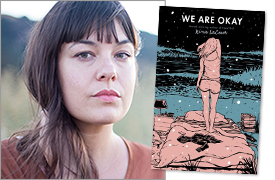
Nina LaCour is the author of contemporary realistic YA novels including Hold Still (2009), Everything Leads to You (2014), and You Know Me Well (2016), a collaboration with David Levithan. Her latest book, We Are Okay, is told from the eyes of Marin, a college freshman who looks forward to spending winter break alone on her deserted East Coast campus. But when more-than-friend Mabel pays a visit from California, Marin must face the tragedy that she’s kept to herself since the previous summer. LaCour, who was chosen as a Flying Starts author for her first book back in 2009, spoke with PW about charting physical and emotional landscapes and drawing inspiration from teaching.
We Are Okay has a Valentine’s Day pub date. Would you describe it as a love story?
Partially, yes. It’s a love story in the broadest sense, in that it’s about the way that people impact one another, and how they try and fail and try again, and don’t allow people in, and then change their minds. In that sense, yes.
What was the origin moment for the novel?
I’d been interested for some time in writing a novel that would take place over a short period of time, examining small moments and the meanings that they hold, and creating a confined setting for my character. Like these small moments, I was interested in small objects and in the emotional attachments people can put on them. In figuring out how to plot and pace the story, I decided I would flash between time periods. This was different from other novels I’d written, because it came from the desire to explore a structure. The other novels came from the desire to explore characters and voices.
Then I needed a story to put into the structure. My grandfather had died a few months earlier and my wife suggested that I write a story about a girl and her grandfather. My own story was very simple and loving. The novel took on a darker tone, but still with the core of love and family.
The book takes place both in San Francisco and at a college on the East Coast. What role did geography play in shaping Marin’s story?
I’m from California; I’ve only ever lived in California. So snow has a magical appeal to me. Going along with the confined setting, looking out into the snow and the stillness of that—I thought it would be a poetic setting. San Francisco is home to me, so that’s a natural default. Because Marin has gone through such an emotional shift, it made sense to locate her on both ends of the country—to reflect the cavern between her old life and new life.
As a college freshman, Marin is slightly older than the average YA heroine. What drew you to write for that age group this time around?
My characters have been getting older and older. When writing We Are Okay, I didn’t know if placing Marin in college rather than the summer after high school would be a problem in terms of publishing, or if my editor would object. But I couldn’t see any way she would be alone, with no adults, if she hadn’t been. Even if it had been a boarding school over winter break, she would’ve had to be with someone. It was necessary for the isolation I was looking for. Luckily my editor, Julie Strauss-Gabel, was on board.
From the opening, we’re aware that Marin is coping with trauma, but the details aren’t revealed until much later. Why did you decide to handle it that way, and was it difficult to sustain the feeling of tension?
I chose to handle it that way because in the present, even though Marin knows what happened, she’s not allowing herself to confront it. She’s living in a place of trying to hold herself together. Her way of doing that is to distract herself. With Mabel’s arrival and visit, she’s slowly allowing herself to look at herself in a way that she hasn’t before. I wanted the reveal of details to echo her process of opening up to Mabel and to herself, as well. I think tension is what makes the story work for me. That tension is necessary for her to grow in the way I needed her to.
There’s a tinge of the Gothic and ghostly in the novel. Marin is a fan of The Turn of the Screw and Jane Eyre. How did the genre influence you as you were writing?
I love Gothic literature! When I was a high school teacher, I got to teach an elective on it for juniors and seniors. I’ve studied and taught those books a lot and I’m drawn to the themes. It’s a natural progression, I suppose, of seeing the things I love become what my characters love. I was also interested in examining what it’s like to love books and then to have a traumatic thing happen, and revisit them—to have them ring more true.
And it’s a traumatic way that Marin lost Gramps. I thought the idea of ghosts was central to the story. When I first started writing, I toyed with the idea of having actual ghosts. Sometimes I write something like that, but then revert to my natural form of realism. There are ghosts in the story, but not in a Gothic way—in a psychological or emotional way.
You mentioned your work as a teacher. How has that informed your writing?
I taught high school for six years and stopped when I had my daughter. I just started teaching for Hamline University’s MFA program in Minnesota. It’s been great to return to books in an academic way, and also in a way that appreciates all the ways that books are made. I just gave a lecture at Hamline’s residency on setting. I was really interested in setting when writing We Are Okay, and it let me take a look at what I had done and what others had done in a more thorough way. The beauty of teaching is that you’re always forcing yourself to learn so much and also teaching those around you. It’s a wonderful place to be.
What do you think are some of the challenges facing “new adults”?
It’s a time in life I’ve been interested in. I’ve been gravitating to newly-graduated 18- and 19-year-olds. Before that age, everything is mapped out in terms of school and what you’re supposed to be doing. Suddenly you graduate. And sometimes college is the right choice—sometimes not yet, or not ever. The world can open up quickly in a terrifying way, if you’re not ready for it. And the confines of what you’re expected to do drop away. The future is wide open and yet uncertain.
You’ve also worked as a bookseller. How has that experience served you as a writer?
For my first job, I started working as a bookseller at 14. I worked at three indie bookstores, up until I graduated from my master’s program. It was really influential. I always loved reading. My first job was to enter ISBNs into the store’s inventory system. I remember imagining, “One day I’ll have an ISBN of my own!”
And I discovered books I never would have, by looking at every single book and taking them out of boxes. Some became influential. I’ve been thinking a lot about Out of the Girls’ Room and into the Night by Thisbe Nissen. I discovered it because the manager of the store really loved that book, and I ended up reading it constantly. It’s stories of young women—not YA but very much this kind of teen, early 20s experience of women. I think it was such a wonderful environment as a kid and as an adult, too.
And do you have any favorite local bookstores?
Yes! I used to work at Diesel in Oakland. It’s still my favorite. And A Great Good Place for Books, also in Oakland, is a wonderful store. Mrs. Dalloway’s in Berkeley has a beautiful selection. (Mrs. Dalloway also happens to be one of my favorite books.) It’s unexpected because they also sell gardening supplies—a winning combination in my mind! And the indie chain Books Inc. always throws amazing events.
What are some of your writing rituals?
I like to have a clear surface. Visual clutter is disturbing to me when I work. And ever since I was a teenager, I’ve listened to one song on repeat. Listening in a loop like that allows me to get into the groove of the story. Eventually the lyrics and even the sound of the song fade away. It allows me to tune out the world and to work.
My daughter is now in preschool three mornings a week, so I’m starting to get a semblance of a writing schedule again. It’s a welcome change.
You recently collaborated with David Levithan. What was it like shifting back into the solo approach for We Are Okay?
I had actually written We Are Okay at the same time as You Know Me Well. But I think of the collaboration as this really fun game. It felt much more playful and exciting. I would wait for [David’s] part to come to my inbox. It was like this little gift. And I’d pick up where he left off.
When I’m writing on my own, obviously it’s solitary—entirely mine. There’s the difficulty of figuring things out on my own and being completely in my own head. There’s also the joy of being able to have complete control over a project. The biggest difference is that I don’t usually write in a linear way. I scene-hop: writing little scenes or moments from all over the novel. But I had to write in a linear way with David. So it was a sigh of relief to write scenes again in the way I was used to.
Can you tell us about what you’re working on next?
I’m not far into it yet. It has to do with sisters. I’ve been drawn to sisters lately. I don’t have a sister, but keep thinking about that dynamic. I think, also, they’ll be on the older end of YA. It’s kind of exploring what happens next after a loss. And the loss will be a different kind than Marin’s.
We Are Okay by Nina LaCour. Dutton, $17.99 Feb 14 ISBN 978-0-525-42589-2