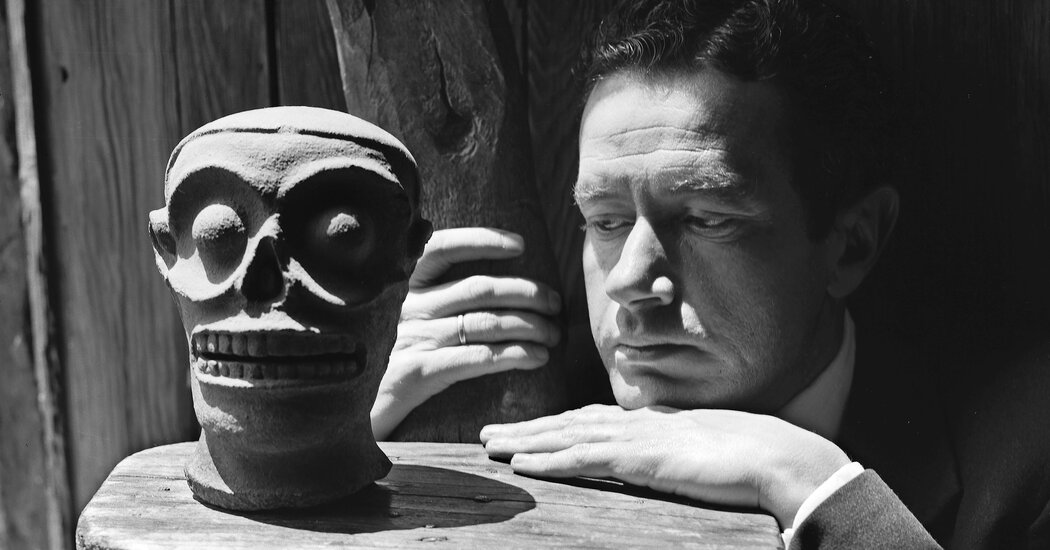
But at its core, “Pedro Páramo” is a tale of two journeys, or perhaps one journey that unfolds into two. The first is a linear one driven by a Telemachean quest: a man searching for his missing father. The narrator, Juan Preciado, goes to his parents’ hometown after his mother dies, seeking his long-estranged father, Pedro Páramo. He plans to demand reparations. But what he finds is a ghost town. Then he dies. (This is not a spoiler; the story continues after his death as if nothing really happened.) The second journey is Dantesque: a spiraling descent into a kind of underworld. But unlike Dante’s mathematically plotted inferno, with its concentric circles and somewhat navigable geography, Rulfo’s is largely sensory, densely packed with sounds and their endless reverberations.
Many Latin American readers know the opening sentence of the novel by heart: “Vine a Comala porque me dijeron que acá vivía mi padre, un tal Pedro Páramo.” From the beginning, we find ourselves in an unstable space-time that we will question and redefine as we move through the novel. For English-language readers, key differences in two translations of the opening line will help bring this ambiguity to light. The 1994 translation, by Margaret Sayers Peden, reads: “I came to Comala because I had been told that my father, a man named Pedro Páramo, lived there.” The most recent translation, by Douglas J. Weatherford, is: “I came to Comala because I was told my father lived here, a man named Pedro Páramo.” Just as the exchange of “here” for “there” radically changes the story’s spatiality (where the narrator is speaking), the use of “was told” — less removed than “had been told” — shifts its temporality (when the narration happens).
Nothing can fall into place in a novel if the author does not have control over its sense of time, be it linear or fractured. In novels of fractured time, the sequence of events must be governed by a logic of its own, one justified by the book’s central questions. Throughout “Pedro Páramo” — in which a central concern is how the world of the living haunts the world of the dead, and not vice versa, as with most ghost stories — time ebbs and flows in a kind of tidal pattern. It is not quite circular, because circles are closed circuits, but the cadence is similar to something cyclical, to the uprush and backwash of water breaking over sand, over and over again. The dead, tormented by lives they can no longer participate in but which their memories replay, over and over again, produce a steady undercurrent of murmurs, laments, mutterings, chatter, whispers, quiet confessions.
If where and when we are in “Pedro Páramo” is constantly shifting, then sound is the swift and sinuous vehicle that carries us through it. For a class I taught this fall, I asked my students to find the many sonic markers in the novel. (It was a fun experiment, and we shared the results with the sound designers of a forthcoming “Pedro Páramo” film. They wrote back to say they were inspired by our sound lists and wanted to credit the students.)
I was astonished to see how much of the novel is composed of aural details. Still air shattered by doves’ flapping wings. Hummingbirds whirring among jasmine bushes. Laughter. A tap of knuckles on the confessional window. A church clock ringing out the hours, “one after another, one after another, as if time had contracted.” Also sounds we cannot hear, but can almost imagine: “the earth rotating on rusted hinges, the trembling of an ancient world pouring out its darkness.” And of course, the myriad sounds of rain.