
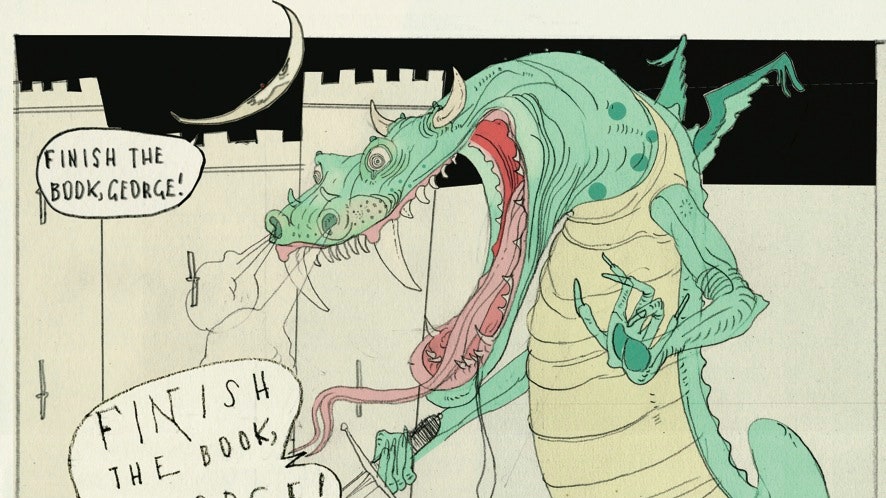

George R. R. Martin’s story suggests a new sense of what an author owes his readers.Illustration by DAVID HUGHES
The writer George R. R. Martin left Hollywood in 1994, determined to do what he wanted for a change. He’d had some success in television, working on a new version of “The Twilight Zone” and on the fantasy series “Beauty and the Beast.” But the pilot for “Doorways,” a series he’d developed, hadn’t been picked up, and he was tired of the medium’s limitations. “Everything I did was too big and too expensive in the first draft,” he told me recently. He wanted castles and vistas and armies, and producers always made him cut that stuff. A line producer for “The Twilight Zone” once explained to him, “You can have horses or you can have Stonehenge. But you can’t have horses and Stonehenge.”
On the printed page, however, he could have it all. He recalls telling himself, “I’m going to write a fantasy and it’s going to be huge. I’m going to have all the characters I want and all the battles I want.” In 1996, he published a novel of seven hundred pages, “A Game of Thrones,” the first volume of a projected trilogy called “A Song of Ice and Fire.” The series chronicles the struggle for power among several aristocratic families in the Seven Kingdoms, an imaginary medieval nation. In a genre crowded with stale variations on what Joseph Campbell called “the hero’s journey,” with plots distilled from ancient legends, Martin took his inspiration from history instead of from mythology; he based his tale, loosely, on the Wars of the Roses, the bloody dynastic struggles in medieval England. Compared with most epic fantasy fiction, Martin’s story contained relatively little magic, and it felt dangerous, lusty, and real.
Although “A Game of Thrones” was not initially a hit, it won the passionate advocacy of certain independent booksellers, who recommended it to their customers, who, in turn, pressed copies on their friends. A following was born, albeit a spotty one. Parris McBride, Martin’s wife, recalls, “When George went on the first signing tour for the series, the manager at Joseph-Beth Booksellers, in Kentucky, had four hundred people waiting for him. A few weeks later, he’s in St. Louis, and nobody turns up for the signing at all.”
The days when nobody showed up for a Martin signing are long gone. In January, at a hastily scheduled appearance at Vroman’s Bookstore, in Pasadena, hundreds of fans waited in a line that coiled around the store. They presented Martin with volumes from “A Song of Ice and Fire” and works from his early years as a science-fiction writer, as well as with calendars, posters, e-readers, yellowing pulp magazines, and replica swords. Three young women wore handmade T-shirts emblazoned with the coats of arms of their favorite clans from the series. Martin was unflaggingly attentive to his supplicants, including the couple who asked him to pose for a photograph with their infant daughter, who was named Daenerys, for one of his heroines.
Martin has now sold more than fifteen million books worldwide, and his readership will likely multiply exponentially after the launch, this month, of “Game of Thrones,” a lavish HBO series based on “A Song of Ice and Fire.” He is committed to nurturing his audience, no matter how vast it gets. “It behooves a writer to be good to his fans,” he says. He writes a lively blog, and though he has an assistant, Ty Franck, who screens the multitude of comments that are posted on it, he tries to read many of them himself. A fan in Sweden, Elio M. García, Jr., maintains an official presence for Martin on Facebook and Twitter, and also runs the main “Ice and Fire” Web forum, Westeros.org. (Westeros is the name of the fictional continent that is home to the Seven Kingdoms.) When Martin is travelling, which is often, he attends the gatherings of the Brotherhood Without Banners, an unofficial fan club with informal chapters around the world, and he counts its founders and other longtime members among his good friends. In many respects, he’s a model for contemporary authors confronted with a wobbly publishing industry and a fractured marketplace. Anne Groell, Martin’s editor at Random House, tells her authors, “Outreach and building community with readers is the single most important thing you can do for your book these days. You need to make them feel invested in your career.”
Still, a close relationship with one’s audience has its drawbacks. As Martin puts it, “The more readers you have, the harder it is to keep up, and then you can’t get any writing done.” He added to his burden when he decided that his planned trilogy needed to be at least a seven-book series. “The tale grew in the telling,” Martin often says, quoting J. R. R. Tolkien, a writer he greatly admires.
The tale also got stalled. There has been no addition to the “Song of Ice and Fire” series since 2005, when the fourth volume appeared. And that book, titled “A Feast for Crows,” was only half a novel: it had been surgically removed from a manuscript that, at twelve hundred pages, still wasn’t complete nearly five years after the publication of the third volume. Because “A Feast for Crows” followed the adventures of a number of new characters—and left the fates of several popular characters unresolved after the previous book’s cliffhanger ending—some fans were disappointed by it. Martin included a postscript in “A Feast for Crows,” explaining what he’d done—and then, as he told me, “I made the fatal mistake of saying, ‘But the other book is half-written and I should be able to finish it within a year.’ ”
In the six years since, some of Martin’s fans have grown exceedingly restless. The same blogging culture that allows a fantasy writer like Neil Gaiman to foster a sense of intimacy with his readers can also expose an author to relentless scrutiny when they become discontented. Fans desperate to find out what happened to Martin characters like Tyrion Lannister—a smart, cynical dwarf born into one of the most powerful families in the Seven Kingdoms—found it irksome to check Martin’s Web site for updates about the series’ fifth book, “A Dance with Dragons,” and find instead postings about sports or politics. They began to complain in the comments section of Martin’s blog and on Westeros.org.
As the chief moderator of Westeros.org, García deleted forum posts that he regarded as “not constructive,” including increasingly wild speculation about the cause of the delay and the ultimate fate of the series. Martin’s blog was similarly monitored. Even so, the discontent soon spilled over into other platforms—from science-fiction and fantasy forums to discussion boards on Amazon.com. One poster wrote, “George R. R. Martin, you suck. . . . Pull your fucking typewriter out of your ass and start fucking typing.” Another joked that Martin had written a book called “How to Cash in Big Time After You Write Half a Series.” Such invective has flourished even after Martin, in early March, announced that “A Dance with Dragons” will finally be published on July 12th. One skeptic, posting on Amazon.com, said of the release date, “Don’t hold your breath on this one unless you like passing out.”
An entire community of apostates—a shadow fandom—is now devoted to taunting Martin, his associates, and readers who insist that he has been hard at work on the series and has the right to take as much time as he needs. Even Gaiman got dragged into the feud when he responded, on his own blog, to an inquiry about Martin’s tardiness by issuing this reproof: “George R. R. Martin is not your bitch.”
The online attacks on Martin suggest that some readers have a new idea about what an author owes them. They see themselves as customers, not devotees, and they expect prompt, consistent service. Martin, who is sixty-two, told me that Franck calls the disaffected readers the Entitlement Generation: “He thinks they’re all younger people, teens and twenties. And that their generation just wants what they want, and they want it now. If you don’t give it to them, they’re pissed off.”
Martin and McBride live in a stucco house in Santa Fe. Martin also owns the place across the street, which he uses as an office. He’s converted the closets into dioramas to display his large collection of miniatures. Most of them are medieval, with the knights outnumbering infantrymen—“I like the pageantry and the color,” he told me, his voice still tinged with the accent of his home town, Bayonne, New Jersey. When I visited, in January, Martin, a short, portly man whose jaw is fringed with a gray beard, opened a door in the hallway to show me a tiny scene from the banqueting room of a castle, complete with gossiping ladies, an amorous couple, dogs begging for scraps, and a drunk passed out with his head on the table.
Like his closets, Martin’s head is crammed with people. By García’s count, there are already more than a thousand named characters in “A Song of Ice and Fire,” although many of them are mentioned only in passing. Martin was startled by the size of García’s census, but he enjoys being surprised by his own work. He thinks of himself as a “gardener”—he has a rough idea where he’s going but improvises along the way. He sometimes fleshes out only as much of his imaginary world as he needs to make a workable setting for the story. Tolkien was what Martin calls an “architect.” Tolkien created entire languages, mythologies, and histories for Middle-earth long before he wrote the novels set there. Martin told me that many of his fans assume that he is as meticulous a world-builder as Tolkien was. “They write to say, ‘I’m fascinated by the languages. I would like to do a study of High Valyrian’ ”—an ancient tongue. “ ‘Could you send me a glossary and a dictionary and the syntax?’ I have to write back and say, ‘I’ve invented seven words of High Valyrian.’ ”