
• Home
  • Editorial
  • Featured New Authors
  • Anthologies
    • Moguls Unleashed
      • Dr. Jane Mukami
      • Dr. Demaryl Roberts-Singleton
      • Dr. Desirie Sykes
      • Dr. Terry Golightly
      • Dr. Shontae Davidson
      • Dr. Adrienne Velazquez
      • Dr. Nichole Pettway
      • Dr. Daniela Peel: Corporate Wellness
  • News and Updates
  • More
    • Multimedia
    • Author of the Month
    • Book Reviews
    • Interviews and Conversations
    • Community and Engagement
    • Writing Resources
    • Genre Explorations
No Result
View All Result
Leading Authors Of Today's Magazine
No Result
View All Result

What Happens to Literature When Writers Embrace A.I. As Their Muse?

May 25, 2024
in How-to
0
Home How-to
0
SHARES
0
VIEWS
Share on FacebookShare on Twitter
What Happens to Literature When Writers Embrace A.I. As Their Muse?


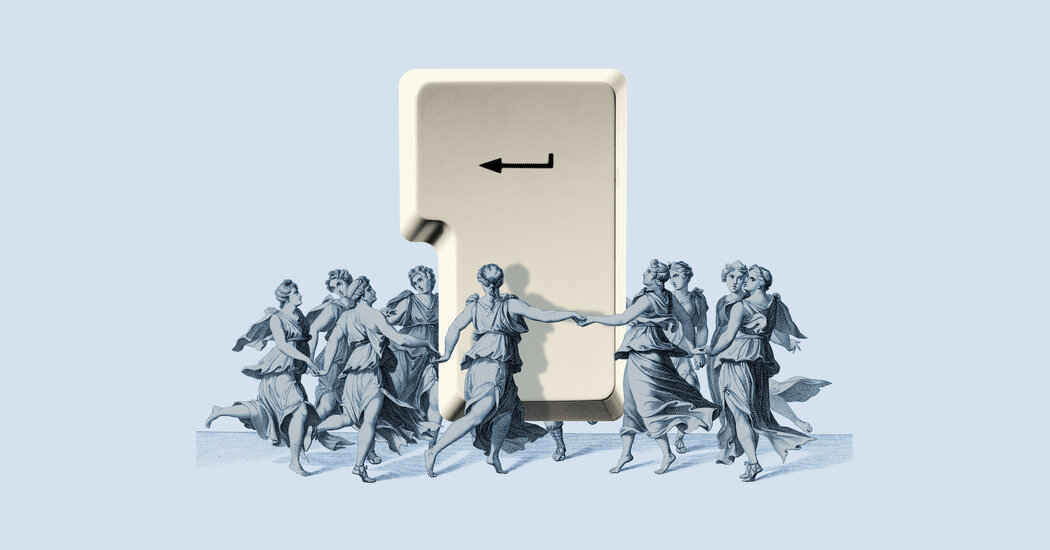
For the Surrealists, automatic writing was a gateway to the unconscious — to both the buried desires of the individual and the chthonic impulses of the species. For Yeats, automatism was a portal to the world of spirits. The medium was his wife, Georgie, who shortly after their marriage in 1917 revealed herself to have oracular powers. As Yeats’s biographer Richard Ellmann put it, Yeats “had married into Delphi.” What Georgie wrote down became the basis of the poet’s later work, including “A Vision,” which attempted “to embody in systematic form … the fragmentary revelations of the automatic script.”

“A Vision,” Yeats’s longest piece of prose, is hardly his most beloved work, but its elaborate system of symbols and patterns undergirds some of his greatest poems, including “The Second Coming,” with its apocalyptic images of widening gyres and centrifugal motion. What was revealed via Georgie Yeats’s automatism was the hidden order of the universe, a cosmology that echoes other mythologies and theories of history while asserting its own stubbornly idiosyncratic truth.

Yeats’s is not the only such system discovered — synthesized? inferred? — by an English-language poet in the 20th century. In 1955, the poet James Merrill and his lover, David Jackson, began contacting spirits with a Ouija board. Almost 30 years later, Merrill published “The Changing Light at Sandover,” a 560-page, 17,000-line poem culled largely from transcripts of their sessions at the board.

Like Georgie Yeats, Jackson was the medium — the “hand,” in Ouija parlance, with Merrill as the “scribe” — and through him the couple contacted a variety of voices, including deceased friends and famous literary figures. The main spirit guides, starting with an enslaved Jew from ancient Greece named Ephraim and proceeding through the archangel Michael and a peacock named Mirabell, transmit elaborate otherworldly knowledge to their human interlocutors via a Q. and A. format that will look familiar to anyone who has quizzed a bot about its tastes and origins.

The questions of whether the poet really believed in the board and how much he embellished its messages always hover over “Sandover,” but as in the case of the Yeatses and “A Vision,” such skepticism is finally moot. For Merrill, language is a definitively human medium; spiritual meanings become intelligible only through a process of translation, which is to say via his and Jackson’s own sensibilities and experience:

Hadn’t — from books, from living —
The profusion dawned on us, of “languages”
Any one of which, to who could read it,
Lit up the system it conceived?

Heti’s Alice would likely recognize a certain kinship with Merrill’s Ephraim, even if their cosmological origin stories and linguistic styles could not be more different. “Sandover” is, at heart, the result of a predigital large language model of literary creation, based on the interaction between a human mind and some kind of intelligence outside it.

Is this a matter of metaphysics, or of technique? Are we interested in the messengers — the chatbots and the Ouija-board revenants — or in the messages they deliver? Those messages, after all, are about us: our fate, our origin, our fragile human essence. Everything we can’t figure out by ourselves.




Read More

Previous Post

Legendary Adman Maurice Saatchi on His New Book, ‘Orgasm’

Next Post

Pakistani-American author Hafsa Lodi launches online hub at Emirates Literature Festival

Next Post
Pakistani-American author Hafsa Lodi launches online hub at Emirates Literature Festival

Pakistani-American author Hafsa Lodi launches online hub at Emirates Literature Festival

Leave a Reply Cancel reply

Your email address will not be published. Required fields are marked *

Random News

Podcast: Reading Hannah Arendt

Podcast: Reading Hannah Arendt

...

20 Best Books Like Fourth Wing to Read Next

20 Best Books Like Fourth Wing to Read Next

...

Conversation with Robert Jensen on his New Book, ‘It’s Debatable’ | Centering on Peace

Conversation with Robert Jensen on his New Book, ‘It’s Debatable’ | Centering on Peace

...

How to Brainstorm a Novel with AI in 2025 (Full Guide)

How to Brainstorm a Novel with AI in 2025 (Full Guide)

...

[Playlist] Morning Mood 🍀 Music that makes u more inspired to study & work

[Playlist] Morning Mood 🍀 Music that makes u more inspired to study & work

...

NYT Spelling Bee Answers for May 14, 2024

NYT Spelling Bee Answers for May 14, 2024

...

About us

Today's Author Magazine

Welcome to Today's Author Magazine, the go-to destination for discovering fresh talent in the literary world. We shine a light on new authors and captivating anthologies, providing readers with a diverse array of stories and insights. Here's a look at the vibrant categories that make up our magazine

RecentNews

Building Bridges, Changing Lives, and Empowering Global Leaders

Still Here: A Story of Resilience, Faith, and Purpose Dr. Samuel Malone

Bishop Funke Adejumo: Writing Her Legacy Into Nations

Elevating Leadership, Empowering Women: The Journey of Dr. Janet Lockhart-Jones

Categories

  • Anthologies
  • Author of the Month
  • Book Reviews
  • Community and Engagement
  • Editorial
  • Featured
  • Featured New Authors
  • Genre Explorations
  • Global Influence
  • How-to
  • Interviews and Conversations
  • Multimedia
  • News and Updates
  • Other
  • Uncategorized
  • Writing Resources

RandomNews

‘Children can change the world’: Aotearoa children’s writers on why they write for kids

Should Screenwriters Adapt Their Screenplays into Novels and Short Stories?

Travis Kelce Doesn’t Know What Books Are on His Shelf, Surprises Jason

‘Books can be mirrors or books can be windows’: How to decide what kids should read

Nahla Ayed has a new book out, The War We Won Apart

  • Home
  • About
  • Privacy
  • Terms
  • Contact

© 2024 Today's Author Magazine. All Rights Are Reserved.

No Result
View All Result
  • About
  • Contact
  • Home
  • Moguls Unleashed
  • Privacy
  • Terms

© 2024 Today's Author Magazine. All Rights Are Reserved.